
Oil Absorbent Meltblown Fabric: How to Compare Absorption Capacity and Oil Retention
When sourcing oil absorbent meltblown fabric, buyers may come across supplier claims such as “high oil absorption capacity,” “fast absorption,” or “low oil release after absorption.” However, these descriptions refer to different performance characteristics.
For buyers of industrial oil absorbent rolls, pads, and oil spill cleanup materials, the key question is not simply how much oil a material can absorb. They also need to know how quickly it absorbs oil, whether it absorbs water as well, and how much oil it can retain during draining, handling, or compression.
If suppliers use different oils, contact times, and draining methods during testing, their reported oil absorption ratios may not be directly comparable. Buyers should first establish consistent test conditions before deciding whether a material is suitable for the intended end product.
1. High Oil Absorption Does Not Automatically Mean a Material Is Suitable for Your Product
Oil absorption capacity generally describes how much oil a certain mass of material can absorb under specified test conditions. Suppliers may express it as the mass of absorbed oil per gram of material or as the ratio of absorbed oil mass to the original dry material mass.
However, this figure alone cannot determine how the material will perform in actual use.
For example, two samples may show similar oil absorption capacity under specified conditions, but one may take considerably longer to reach that absorption level. The other may absorb a large amount of oil within a shorter period. For applications involving rapid spill cleanup, absorption speed may be more important than the final absorption capacity.
Another situation is also possible: a material may absorb a considerable amount of oil during an immersion test, but release some of that oil when removed from the liquid, drained, or compressed. Even if its initial absorption capacity is relatively high, it may not be suitable for products that need to be handled, collected, or moved after absorbing oil.
Therefore, buyers should distinguish between at least four performance characteristics:
Performance Indicator | What It Means | What Buyers Should Confirm |
Oil absorption capacity | The amount of oil absorbed under specified conditions | How much oil does the material absorb per gram? Which oil is used for testing? |
Oil absorption rate | How quickly the material absorbs oil or reaches a specified absorption level | How long is the test? Are results recorded at different time intervals? |
Oil selectivity | How the material absorbs oil and water when both are present | Has the material been tested in an oil-water mixture? How are the two liquids measured separately? |
Oil retention | How much oil remains in the material after specified draining or compression conditions | How long is the draining period? Is pressure applied? How much oil remains after testing? |
These indicators are related, but they are not interchangeable. Buyers should determine which ones are essential acceptance criteria according to the intended end use.
2. How Should Buyers Compare the Oil Absorption Capacity of Different Meltblown Fabrics?
When comparing oil absorption capacity, the first step is to understand how each supplier calculates it.
One common way to express the result is as the ratio of absorbed oil mass to the original dry sample mass:
Oil absorption capacity (g/g) = Absorbed oil mass (g) ÷ Dry material mass (g)
For example, if a dry sample weighs 1 g and the calculated absorbed oil mass is 5 g under the agreed test procedure, the oil absorption capacity under those test conditions is 5 g/g.
This figure is only an example to explain the calculation. It is not a JHC product test result or a universal industry performance standard.
For an actual purchasing evaluation, suppliers must explain how the absorbed oil mass is determined. After a sample is removed from the oil, some liquid may remain on its surface. If the draining procedure or method for removing free surface oil is not standardized, the measured weight may include different amounts of surface oil.
As a result, oil absorption figures from different suppliers are meaningful only when their test conditions and calculation methods are sufficiently consistent.
Test Conditions That Should Be Standardized
Target oil
Different oils may have different viscosities, densities, temperatures, and compositions. Lightweight oils and high-viscosity oils may behave differently when penetrating and moving through a material. Buyers should use the oil from their actual application whenever possible, or at least ask suppliers to identify the oil used in testing.
If the final product is intended for lubricating oil, hydraulic oil, diesel, or another industrial liquid, a test result obtained with one type of oil should not automatically be applied to all other oils.
Sample specifications
Sample mass, length, width, thickness, and sampling location may all affect the test result. When comparing different materials, buyers should use consistent sample preparation methods and record the initial dry mass.
If one sample is considerably thicker or has a higher basis weight than another, comparing only the total amount of oil absorbed by each sample may lead to misleading conclusions. For material purchasing, it may be useful to record both oil absorption per unit mass and oil absorption per unit area. The appropriate acceptance indicator should be determined according to the final product design.
Contact time
Oil absorption is not a fixed value independent of time. Testing for 30 seconds, 5 minutes, or a longer period may produce different results.
If the application involves rapid spill cleanup, buyers should focus on the material's absorption performance over a short period. If the material needs to remain in contact with oil around equipment or in maintenance areas, its absorption behavior over a longer period should also be considered.
Test temperature
Oil temperature affects its flow characteristics. If the actual operating temperature differs from the laboratory test temperature, the test result may not fully represent real-use performance.
Suppliers should record the test temperature and explain whether it is representative of the intended operating environment.
3. What Is the Difference Between Oil Absorption Speed and Final Absorption Capacity?
Oil absorption rate focuses on the absorption process rather than the total amount of oil a material can eventually absorb.
For industrial spill cleanup products, absorption speed may directly affect cleanup efficiency. When an oil spill occurs, the absorbent material needs to come into contact with the liquid and absorb it within a limited period.
However, a faster absorption rate does not necessarily mean a higher final absorption capacity.
One material may absorb oil quickly at the beginning but show only a limited increase afterward. Another may absorb oil more slowly at first but continue absorbing more over a longer period. Therefore, a result recorded at only one time point is not enough to describe the entire absorption process.
Buyers can ask suppliers to record absorbed oil mass at multiple time intervals under the same test conditions, such as an initial short contact period, several minutes, and an agreed final test time. The specific intervals should be determined according to the application and the test procedure agreed by both parties. No single time interval should be treated as a universal standard for all oil absorbent materials.
For oil absorbent pads used to clean up spills quickly, short-term absorption performance may be more important. For oil absorbent rolls that remain in contact with oil for an extended period, changes in absorption over time should also be evaluated.
4. Why Should Oil Retention Be Tested Separately After Absorption?
Oil retention describes how much oil remains in a material after absorption when it is subjected to specified draining, handling, or compression conditions.
Absorption capacity and retention are two different performance indicators.
A material may absorb a large amount of oil during immersion or contact testing. However, after it is removed from the oil, some of the liquid inside or on its surface may drain out under gravity. If the material releases additional oil during handling or compression, the finished product may cause dripping, contamination, or insufficient liquid retention during use.
Therefore, buyers should not request only the initial absorption capacity. They should also define how the material will be handled after absorption.
Draining Test
After the sample reaches the specified absorption time, it is removed from the oil and drained according to an agreed procedure. The draining position, draining time, and whether surface free oil can be removed by an additional method should be recorded.
Different draining periods may produce different final weight measurements. Vertical hanging, horizontal placement, and other draining positions may also result in different amounts of liquid loss.
Therefore, an oil retention result must include its draining conditions. A retention percentage without an explanation of the test procedure is not sufficient.
Compression Test
If the absorbent material will be exposed to pressure during handling, stacking, packaging, or actual use, buyers should also evaluate how much oil it releases under compression after absorption.
The test should define the applied pressure, contact area, duration, and loading method. Different pressure conditions can produce different results. Therefore, a general statement such as “resistant to squeezing” cannot replace test data with clearly defined conditions.
For absorbent pads that need to be handled or stacked after use, oil retention under compression may be an important acceptance criterion.
How Can Oil Retention Be Expressed?
Once both parties have agreed on a draining or compression procedure, oil retention can be calculated by comparing the oil remaining after the test with the oil absorbed before that procedure.
Oil retention (%) = Oil mass retained after the specified draining or compression procedure ÷ Oil mass absorbed before the procedure × 100%
The key is that the numerator and denominator must correspond to the same clearly defined test procedure.
If one report uses a 1-minute draining period and another uses 10 minutes, or if one test includes compression while the other does not, their oil retention percentages cannot be compared directly.
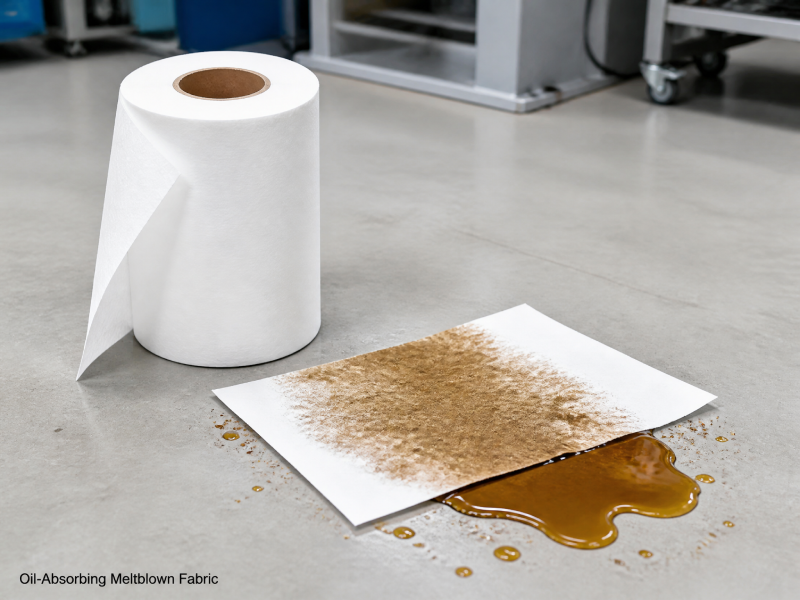
5. Does PP Meltblown Fabric Automatically Have Oil-Water Selectivity?
PP Meltblown Fabric is often discussed in connection with oil absorbent materials. However, buyers should not assume that every meltblown fabric made from polypropylene has the same oil-water selectivity simply because it uses PP as its raw material.
Oil-water selectivity describes the actual behavior of a material in a specific liquid environment. It needs to be evaluated according to the material structure, surface characteristics, treatment method, and test conditions.
When oil and water are present together, buyers need to understand how much oil the material absorbs, how much water it absorbs, and how much of each liquid remains in the material after testing.
If a supplier provides only an oil absorption result obtained with a single oil, that result cannot prove that the material will show the same selectivity in an oil-water mixture.
How Should Oil-Water Selectivity Be Verified?
First, define the oil-water environment. The test oil, water quality, oil-water ratio, and temperature should be as close as possible to the actual application conditions.
Second, define the measurement method after testing. Measuring only the total weight increase of a sample cannot distinguish whether the added mass comes from oil or water. If buyers need to evaluate the separate absorption of both liquids, they should use a test and analysis method capable of distinguishing them.
Finally, define how the results will be used for product acceptance. Some buyers may focus mainly on oil absorption, while others may require the material to minimize water absorption in a water-containing environment. The requirements vary by application, so a general claim of “selective oil absorption” should not replace specific performance requirements.
6. Do Oil Absorbent Rolls and Oil Absorbent Pads Require Different Material Characteristics?
Even when the same meltblown material is used, its performance may differ after it is converted into an oil absorbent roll, pad, or another finished product.
This is because the final product depends not only on the material itself but also on its dimensions, number of layers, composite structure, edge treatment, and conversion process.
Industrial Oil Absorbent Rolls
Oil absorbent rolls are commonly used to cover larger areas, including floors, areas around equipment, and industrial maintenance zones. Buyers should consider how the material performs during continuous supply, unrolling, and placement.
In addition to absorption capacity and oil retention, buyers should confirm roll width, length, thickness, basis weight, ease of unrolling, and whether the material is likely to move during actual use.
If a roll needs to cover a long area, its integrity during unrolling, cutting, and handling is also important. The absorption result from a small laboratory sample alone cannot fully determine how the complete roll will perform.
Industrial Oil Absorbent Pads
Oil absorbent pads are commonly used for localized spills, equipment maintenance, or areas around workbenches. Buyers should consider individual pad dimensions, oil absorption per pad, absorption speed, and handling after use.
If a pad needs to be picked up, transferred, or placed into a disposal bag after absorbing oil, retention and edge integrity may be more important than simply achieving a higher initial absorption capacity.
Other Oil Absorbent Products
Oil absorbent booms, socks, and other customized absorbent products may have different shapes, filling structures, and outer materials. In these cases, buyers should evaluate not only the internal meltblown material but also the performance of the finished product as a whole.
If the material needs to undergo lamination, cutting, edge sealing, or other conversion processes, it is advisable to validate the finished product after the material sample has passed the initial evaluation.
7. Oil Absorbent Materials and Oil Filtration Materials Serve Different Purchasing Needs
Oil absorbent materials and oil filtration materials may both come into contact with oil, but they are designed to solve different problems.
Oil absorbent materials are primarily intended to absorb and retain leaked or residual oil. They are commonly used in oil absorbent pads, rolls, and industrial spill cleanup products.
Oil filtration materials, on the other hand, are designed to allow oil to pass through the material while capturing target particles or other contaminants. Their purchasing requirements typically include filtration efficiency, micron rating, flow rate, pressure drop, and contaminant retention.
Therefore, filtration ratings cannot be used to prove oil absorption capacity, and oil absorption capacity cannot prove that a material provides a particular filtration performance.
If buyers need to remove particles from oil, they should evaluate the material according to filtration requirements. If they need to absorb leaked oil around floors or equipment, they should focus on absorption capacity, absorption speed, oil-water selectivity, and oil retention.
For composite products that involve both absorption and filtration, the two functions should be defined and verified separately. One performance indicator should not be used to represent all functions.
8. What Should Buyers Confirm Before Bulk Purchasing Oil Absorbent Materials?
Before placing a bulk order, buyers should include their oil absorption requirements in the material specification sheet or sample approval document. This helps prevent differences between the test conditions used during sample evaluation and those used for bulk acceptance.
The following information should be confirmed:
Item to Confirm | Information to Provide |
Material type | PP Meltblown Fabric or another material structure |
Final application | Oil absorbent rolls, pads, booms, or other products |
Target oil | Specific oil type, viscosity, or relevant liquid information |
Oil absorption capacity | Test unit, calculation method, and target value |
Absorption speed | Contact time and time intervals to be recorded |
Test temperature | Test temperature and actual operating temperature |
Sample specifications | Basis weight, thickness, dimensions, and initial mass |
Draining method | Draining position, draining time, and surface oil removal method |
Oil retention | Whether compression is applied, pressure conditions, duration, and post-test mass |
Oil-water selectivity | Whether oil-water mixture testing is required and how oil and water will be measured separately |
Finished product requirements | Roll or pad dimensions, number of layers, composite structure, and conversion requirements |
Bulk acceptance | Sample approval criteria, batch inspection method, and allowable tolerances |
If a supplier can provide only an oil absorption ratio but cannot explain the oil type, test duration, draining method, and calculation method, buyers will find it difficult to determine whether the figure is relevant to their application.
For repeat purchasing projects, buyers should also clarify the relationship between sample approval and bulk production specifications. The material structure, basis weight, and thickness of the tested sample should correspond to the specifications agreed for the bulk order. If the material or conversion structure changes, the relevant performance should be confirmed again.
9. How Should Buyers Inquire About Oil Absorbent Meltblown Fabric from JHC?
For an oil absorbent meltblown fabric project, buyers should provide the target oil, final product format, and performance requirements when requesting a quotation, rather than simply asking, “What is the oil absorption ratio of your meltblown fabric?”
HuiZhou JinHaoCheng Nonwovens Co., Ltd. lists oil absorption applications in its meltblown fabric product information and indicates that specifications such as PP material, basis weight, width, thickness, and surface treatment can be discussed according to application requirements. The suitability of a specific material for a particular oil, available treatment options, and achievable absorption performance need to be confirmed according to the actual project requirements.
To help the supplier evaluate the project, buyers can provide the following information:
Inquiry Information | Details to Specify |
Application | Factory spill cleanup, equipment maintenance, oil stain cleanup, or another use |
Final product | Oil absorbent rolls, pads, or other finished products |
Target liquid | Specific oil type and whether oil-water mixtures are present |
Material specifications | PP material requirements, GSM, thickness, and width |
Performance targets | Oil absorption capacity, absorption time, and retention after draining |
Order quantity | Sample requirements and estimated bulk purchasing volume |
Conversion process | Whether further lamination, cutting, or other conversion is required |
If the technical specifications have not yet been fully defined, buyers can first provide product photos, samples, dimension drawings, or application details. The supplier needs to understand how the material will be used before confirming which performance characteristics should be tested.
Conclusion: Oil Absorption Capacity and Oil Retention Must Be Evaluated Together
When sourcing Oil Absorbent Meltblown Fabric, buyers should not compare suppliers based only on their stated oil absorption ratios.
Oil absorption capacity indicates how much oil a material absorbs under specified conditions. Absorption speed describes how long it takes to reach a certain absorption level. Oil-water selectivity reflects the material's absorption behavior in a specific oil-water environment. Oil retention indicates whether the absorbed oil remains in the material after draining, handling, or compression.
Each indicator answers a different purchasing question. Test results become meaningful for comparison only when the oil type, sample specifications, contact time, draining method, and compression conditions are clearly defined.
For finished products such as oil absorbent rolls and pads, buyers should also evaluate the product structure and actual use performance in addition to the material test results. This helps avoid purchasing a material that appears to have a high absorption capacity in laboratory testing but is not suitable for the intended application.




