Polyester, Cotton or Viscose? Fiber Options for Orthopedic Cast Padding
When sourcing materials for orthopedic cast padding, fiber composition is an important factor in material selection. For manufacturers of cast padding, orthopedic undercast padding, and related medical consumables, common material options include 100% Polyester, 100% Cotton, and Polyester-Viscose blends.
These three materials differ in fiber hydrophilicity, hand feel, structural characteristics, and raw material cost considerations. However, the final performance of cast padding cannot be determined by fiber composition alone.
For example, cotton and viscose fibers generally have better hydrophilic properties, while conventional polyester fibers have relatively low inherent moisture absorption. However, the actual performance of needle-punched nonwoven materials is also influenced by fiber proportions, fiber specifications, GSM, thickness, density, and needle-punched structure.
Therefore, the key purchasing question is not which fiber is universally better, but which fiber composition is more suitable for the intended product's requirements for softness, moisture absorption, structural stability, and cost.
This article compares three common material options: 100% Polyester, 100% Cotton, and Polyester-Viscose blends. It explains their characteristics, differences, and the specifications buyers should consider when sourcing orthopedic cast padding.
Why Does Fiber Composition Matter in Orthopedic Cast Padding?
Cast Padding is a cushioning material used in orthopedic casting systems. It is generally placed between the skin and the external casting material. In needle-punched nonwoven padding, fibers not only form the basic material structure but also influence the finished product's softness, moisture absorption, and processing characteristics.
Different fibers have different physical and chemical properties. As a result, materials with the same GSM and thickness may still show different performance characteristics when their fiber compositions differ.
Fiber Hydrophilicity and Moisture Absorption
The inherent hydrophilicity of fibers influences how liquids interact with the material surface and how the material becomes wetted.
Cotton and viscose fibers generally have good hydrophilic properties and are worth considering for product development where moisture absorption is required. Conventional polyester fibers have relatively low inherent moisture absorption, but the pores and internal structure of needle-punched nonwoven materials also influence how liquids enter and spread through the material.
Therefore, buyers should not judge the moisture absorption capacity of the finished material by fiber composition alone. The overall material structure and actual test results also need to be considered.
Fiber Characteristics and Softness
Different fiber fineness levels, lengths, surface characteristics, and processing conditions may influence the feel of the material.
However, softness is not determined by fiber type alone. Even when the same fiber is used, differences in fiber specifications, needling intensity, material density, and thickness can result in different tactile properties.
For cast padding, buyers should define the desired softness and confirm it through actual samples.
Fiber Structure and Stability
Needle-punched nonwoven fabric is formed by mechanically entangling fibers to create a material with a certain thickness and structure.
The strength of the fibers, the degree of fiber entanglement, and the needle-punched structure all influence the overall stability, tensile performance, and processing suitability of the material.
When comparing different fiber compositions, buyers should therefore evaluate both the fiber characteristics and the finished material structure rather than judging product quality by raw material type alone.
What Are the Characteristics of 100% Polyester Cast Padding?
100% Polyester Cast Padding is one of the fiber options that can be considered when developing orthopedic padding materials.
Polyester fibers offer good strength and dimensional stability. In needle-punched nonwoven production, different fiber specifications and structural designs can be used to develop padding materials with different thicknesses, densities, and softness levels.
For buyers, the main considerations when evaluating 100% Polyester include the following.
Structural Stability and Processing Performance
Polyester fibers offer good strength and dimensional stability, making them a material option for projects where structural consistency and processing stability are important.
In needle-punched nonwoven production, the stability of the finished material is also related to fiber length, fiber fineness, needle-punched structure, and material density.
If the product requires slitting, rewinding, or other subsequent processing, buyers can pay particular attention to edge integrity, thickness uniformity, and the structural condition of the material after processing.
Softness Can Be Adjusted Through Material Specifications
100% Polyester does not automatically mean that the material will feel stiff. Nor do all polyester padding materials have the same hand feel.
Fiber fineness, fiber specifications, GSM, thickness, and needle-punched structure all influence the softness of the finished material.
Therefore, buyers should provide their desired hand feel or a reference sample rather than judging product suitability based only on the term 100% Polyester.
Moisture Absorption Should Be Evaluated According to Product Requirements
Conventional polyester fibers have relatively low inherent hydrophilicity compared with cotton and viscose fibers.
However, this does not mean that polyester needle-punched nonwoven materials cannot be considered for products where liquid management is relevant. Liquid penetration and distribution are also influenced by the spaces between fibers, material thickness, density, and other structural factors.
If the finished product has specific moisture absorption or moisture management requirements, buyers should communicate these requirements and confirm material performance through sample testing.
What Purchasing Requirements May Suit This Material?
If buyers place greater emphasis on material structure, dimensional stability, and subsequent processing performance, 100% Polyester can be considered as a candidate material.
However, its suitability for a specific orthopedic cast padding product still needs to be evaluated according to the target softness, thickness, moisture absorption requirements, and relevant validation results.
What Are the Characteristics of 100% Cotton Cast Padding?
100% Cotton Cast Padding is another fiber option that can be considered for orthopedic padding materials.
Cotton fibers have natural hydrophilic properties and generally offer good moisture absorption and a soft feel. Therefore, cotton is worth considering for purchasing projects where natural fiber composition, moisture absorption characteristics, and material hand feel are important.
However, using cotton fibers does not automatically mean that the finished padding will be softer or more comfortable than other materials. Finished product performance still depends on raw material quality, fiber specifications, material structure, and processing methods.
Hydrophilicity and Moisture Absorption
Cotton fibers have good hydrophilic properties and can be readily wetted by water.
For material development projects with moisture absorption requirements, cotton can be considered as one of the candidate fiber options.
However, buyers need to distinguish between the inherent moisture absorption characteristics of cotton fibers and the actual moisture absorption performance of finished needle-punched nonwoven materials. Fiber proportions, GSM, thickness, density, and internal pore structure all influence the final results.
Therefore, buyers should not assume that 100% Cotton will achieve a particular moisture absorption level without testing.
Soft Hand Feel and Fiber Quality
Cotton fibers generally have a soft hand feel, making them a potential option for padding products where tactile properties are important.
However, the quality and specifications of different cotton fiber raw materials may vary. The needle-punching process can also influence the feel of the finished material.
If buyers have specific softness requirements, they should evaluate the material using reference samples or mutually agreed sample standards.
Material Structure and Processing Requirements
The overall structure of 100% Cotton needle-punched nonwoven fabric depends not only on the cotton fibers themselves but also on fiber length, fiber fineness, needle-punched structure, and material density.
For products requiring slitting, rewinding, or further processing, buyers should confirm structural integrity, edge condition, and thickness uniformity during processing.
What Purchasing Requirements May Suit This Material?
If buyers prefer cotton fibers and place particular emphasis on hydrophilicity and a soft hand feel, 100% Cotton can be considered as a candidate option.
However, its suitability for a specific cast padding product still needs to be confirmed according to the finished material structure, thickness, processing requirements, and sample test results.
What Are the Characteristics of Polyester-Viscose Cast Padding?
Polyester-Viscose Cast Padding is a material option that combines polyester fibers with viscose fibers.
The development approach is to adjust the proportions of the two fibers according to product requirements, aiming to achieve a suitable balance of structural performance, softness, and hydrophilicity.
However, a blended composition does not automatically make the material better than 100% Polyester or 100% Cotton. Its final performance depends on the polyester-to-viscose ratio, fiber specifications, and the overall structure of the needle-punched nonwoven material.
Combining the Characteristics of Different Fibers
Polyester fibers can provide a material basis for structural and dimensional stability, while viscose fibers have good hydrophilic properties and can be considered when moisture absorption is an important requirement.
By adjusting the proportions of the two fibers, manufacturers can develop material specifications according to the needs of different projects.
However, buyers should not simply assume that increasing the viscose proportion will always improve the moisture absorption capacity of the finished product, or that increasing the polyester proportion will guarantee a specific level of strength or stability.
Softness and Moisture Absorption Need to Be Evaluated Together
Polyester-Viscose blends can be considered for projects that require a combination of fiber hand feel and hydrophilic properties.
However, softness and moisture absorption are not determined by blending ratios alone. Fiber fineness, GSM, thickness, density, and needle-punched structure also influence the finished material.
When developing blended padding, buyers should therefore define the main performance requirements and confirm the target fiber ratio and sample specifications with the supplier.
Blending Ratios Should Be Determined According to Project Requirements
Different Polyester-Viscose ratios may result in different material characteristics.
If buyers already have an existing product or reference sample, they can provide it to the supplier for comparison. If the required ratio has not yet been determined, buyers can first explain their requirements for softness, moisture absorption, and structural stability before discussing a suitable fiber composition.
For customized materials, the blending ratio should not be treated as a universal fixed formula. It needs to be confirmed according to the actual requirements of each project.
Polyester vs. Cotton vs. Viscose: How Do They Compare in Softness, Moisture Absorption, Structural Stability, and Cost?
In practical purchasing, the differences between 100% Polyester, 100% Cotton, and Polyester-Viscose should be evaluated across multiple material characteristics.
The following comparison is intended to help buyers identify suitable sample evaluation criteria. It does not mean that all finished products with the same fiber composition will have identical performance.
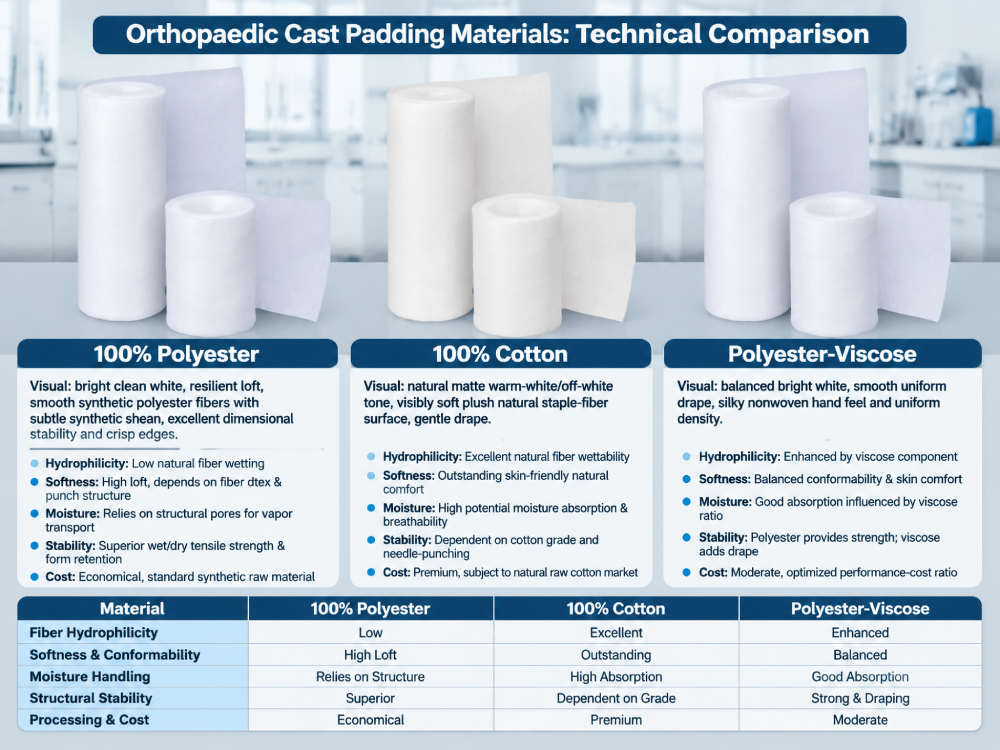
Comparison | 100% Polyester | 100% Cotton | Polyester-Viscose |
Fiber hydrophilicity | Conventional polyester fibers have relatively low inherent hydrophilicity | Generally has good hydrophilic properties | The viscose component has good hydrophilic properties |
Softness | Depends on fiber specifications and needle-punched structure | Depends on cotton fiber quality and material structure | Depends on blending ratio and overall structure |
Moisture absorption | Needs to be evaluated according to material pores and structure | Has good moisture absorption potential; finished material performance requires testing | Influenced by viscose proportion and material structure |
Structural stability | Polyester fibers offer good strength and dimensional stability | Needs to be evaluated according to fiber quality and needle-punched structure | Influenced by polyester and viscose proportions and material structure |
Processing performance | Requires confirmation of thickness, edges, and structure after processing | Requires confirmation of material integrity and processing suitability | Requires evaluation according to blended structure and processing conditions |
Cost considerations | Influenced by polyester raw material prices and specifications | Influenced by cotton raw material prices and quality | Influenced by the prices of both fibers, blending ratio, and processing requirements |
Softness: Fiber Names Alone Are Not Enough
Cotton and viscose generally have a soft hand feel, but this does not mean that every cotton or viscose padding material is softer than polyester.
For needle-punched nonwoven materials, fiber fineness, fiber length, needle-punched structure, material density, and thickness all influence the final feel.
Buyers should ideally provide a reference sample or clearly define the desired softness before confirming it through actual samples.
Moisture Absorption: Distinguish Fiber Hydrophilicity from Finished Material Performance
Cotton and viscose fibers have good hydrophilic properties, while conventional polyester fibers have relatively low inherent hydrophilicity.
However, the moisture absorption performance of the finished material is also related to internal pores, fiber composition, GSM, thickness, and density.
Therefore, buyers should determine the appropriate testing method according to the requirements of the intended product rather than judging moisture absorption capacity by fiber composition alone.
Structural Stability: Evaluate the Material Structure and Processing Conditions
Polyester fibers generally offer good strength and dimensional stability, but this does not mean that 100% Polyester is automatically suitable for every padding product.
Cotton and viscose materials also need to be evaluated according to fiber specifications, needle-punched structure, and actual processing conditions.
For buyers, thickness uniformity, material integrity, edge condition, and structural performance after processing are all important evaluation factors.
Cost: It Is Not Possible to Simply Rank Which Material Is Cheapest
The actual purchasing cost of the three fiber compositions is influenced by raw material prices, fiber quality, blending ratios, GSM, thickness, material waste, processing requirements, and order quantity.
Even the same fiber type may have different quoted prices depending on specifications and purchasing volume.
Therefore, buyers should not judge cost based only on the names 100% Polyester, 100% Cotton, or Polyester-Viscose. Supplier quotations should be compared under the same target specifications and order conditions.
How Should Buyers Choose Fiber Compositions for Different End Products?
For orthopedic cast padding manufacturers, the first step in selecting a fiber composition is not deciding which raw material is better. It is defining the requirements of the finished product.
Different product designs may prioritize different material characteristics. Buyers should therefore determine the fiber composition according to the actual application requirements.
When Structural Stability and Processing Performance Are More Important
If product development places greater emphasis on material strength, dimensional stability, and subsequent processing performance, 100% Polyester can be considered as a candidate option.
However, the final material still needs to be evaluated according to the specific fiber specifications, GSM, thickness, and needle-punched structure.
When Hydrophilicity and Material Hand Feel Are More Important
If the product has clear requirements for hydrophilicity and a soft hand feel, 100% Cotton or materials containing viscose fibers can be considered.
However, buyers should not judge the suitability of the finished product based only on the inherent characteristics of cotton or viscose. Actual samples still need to be evaluated.
When a Balance of Different Material Characteristics Is Required
If a project needs to consider structural stability, softness, and moisture absorption together, Polyester-Viscose can be evaluated as a candidate blended composition.
Buyers can discuss suitable fiber ratios and material structures with the supplier according to the requirements of the intended product.
It is important to note that a higher or lower blending ratio is not automatically better. Different projects have different material requirements, and fiber formulas should not be copied directly from other products.
When the Fiber Composition Has Not Yet Been Determined
For buyers who are beginning to develop cast padding and have not yet selected a fiber composition, they can provide existing product samples, target specifications, or performance requirements.
Based on this information, the supplier can discuss different fiber options and help buyers determine the next material development direction through sample comparison.
If a purchasing project involves both plaster bandages and fiberglass casting tapes, the requirements of the corresponding casting systems should also be considered. For more information about padding selection for different casting systems, refer to cast padding for plaster and fiberglass casting systems.
How Should Buyers Confirm the Final Cast Padding Material Through Samples and Specifications?
After selecting a fiber composition, buyers still need to confirm whether the material meets the requirements of the finished product through specific specifications and sample evaluation.
For orthopedic cast padding, providing only a material name such as Polyester, Cotton, or Polyester-Viscose is usually not enough for a supplier to fully understand the purchasing requirements.
Confirm Fiber Composition and Blending Ratio
First, confirm whether the material should be 100% Polyester, 100% Cotton, or a Polyester-Viscose blend.
If a blended material is selected, specify the target fiber ratio or provide a reference sample so that the supplier can evaluate the material according to the project requirements.
Confirm GSM, Thickness, and Density
GSM, thickness, and density influence the overall structure and performance of the material.
Buyers should provide both weight and thickness requirements whenever possible, rather than specifying only one parameter.
If an existing product is available, a sample or specification sheet can help the supplier make a more accurate material comparison.
Define Softness and Structural Requirements
If the product has specific softness requirements, it is advisable to evaluate the material using a reference sample or a mutually agreed sample standard.
Buyers should also consider thickness uniformity, edge integrity, fiber shedding, and the structural condition of the material after processing.
Confirm Moisture Absorption and Related Testing Requirements
If the product requires specific moisture absorption performance, buyers should define the test liquid, testing conditions, and target indicators.
It is important to distinguish between absorption speed, absorption capacity, and liquid retention. These are not identical performance indicators.
Without clearly defined testing methods and acceptance criteria, test results from different suppliers may not be directly comparable.
Confirm Supply Form and Dimensions
Cast padding can be supplied in rolls or sheets according to project requirements.
Buyers should provide the target width, roll length, sheet dimensions, packaging method, and whether additional slitting or other processing is required.
This information helps suppliers confirm the material specifications and actual supply options.
Confirm Medical Product and Regulatory Requirements
If the finished product is a medical device or another regulated medical product, buyers should explain the target market, intended end use, material contact conditions, and relevant regulatory documentation requirements in advance.
Performance information for ordinary nonwoven materials is not equivalent to registration, certification, or biocompatibility validation of the finished medical product.
For projects requiring sterile supply, sterilization requirements and the relevant validation scope should also be clearly specified in advance.
For JHC's orthopedic cast padding material range, the fiber compositions currently available for discussion include 100% Polyester, 100% Cotton, Polyester-Viscose, and other customized fiber blends. Supply forms include rolls and sheets. GSM, thickness, density, softness, color, width, roll length, and packaging can be further discussed according to project requirements.
The current products are supplied in non-sterile form. If a purchasing project requires sterile supply, specific medical product certifications, or other regulatory documentation, these requirements should be clearly stated during the inquiry stage so that the supplier can confirm the actual scope of applicability.
Buyers who want to learn more about the material characteristics of cotton needle-punched nonwovens used in medical and hygiene products can refer to needle punched cotton for medical and hygiene products.
Conclusion: Select the Right Cast Padding Fiber Composition According to the Finished Product Requirements
100% Polyester, 100% Cotton, and Polyester-Viscose are all potential material options for orthopedic cast padding development. However, there is no universal ranking that makes one composition better than the others for every product.
Polyester can be considered when strength and dimensional stability are important. Cotton and viscose have good hydrophilic properties and can be considered for material development where moisture absorption is a priority. Polyester-Viscose blends allow the proportions of different fibers to be adjusted according to project requirements.
The final material performance still depends on fiber specifications, blending ratios, GSM, thickness, density, needle-punched structure, and processing conditions.
For manufacturers sourcing polyester cast padding, cotton cast padding, or viscose cast padding, we recommend providing the target fiber composition, GSM, thickness, softness, moisture absorption requirements, supply form, and relevant testing standards when requesting a quotation.
By defining clear material specifications, providing reference samples, and agreeing on testing conditions, buyers can compare different fiber compositions more accurately and identify the cast padding material that best suits their product development requirements.