How Many Wash Cycles Can a Reusable Cleaning Cloth Handle? Testing Before Bulk Orders
For importers, wholesalers, and brand buyers sourcing reusable cleaning cloths, good absorbency and a soft feel in a new sample do not necessarily mean that the product will maintain the same performance after repeated washing.
A cleaning cloth may absorb water effectively when first used. However, repeated washing, mechanical friction, and drying may cause changes in absorbency, dimensions, edge integrity, fiber shedding, or surface structure.
These changes can affect the cloth's actual cleaning performance, as well as customer satisfaction and repeat orders.
Therefore, before placing a bulk order for a washable cleaning cloth, buyers should not simply ask suppliers how many times the product can be washed. They should also ask: What washing conditions were used? Which properties were compared before and after washing? At what point should the product be replaced?
This article explains how buyers can establish a repeatable and documented wash durability testing process to evaluate whether a cleaning cloth meets their expectations before bulk purchasing.
Why Good Initial Absorbency Does Not Guarantee Wash Durability
Initial testing mainly shows how a cleaning cloth performs when it is new. Repeated washing tests focus on whether the product continues to meet its original requirements after multiple cleaning cycles.
These are two different aspects of product performance.
For example, a new cleaning cloth may have good absorbency. However, after repeated washing, changes may occur in the fiber bonding, internal material structure, or surface condition. Even if the cloth still looks intact, its absorption speed, liquid retention, or wiping feel may differ from its original condition.
For needle punched nonwoven cleaning cloths, fiber composition, fiber ratio, GSM, thickness, and material structure can all affect product performance. Different material structures may also respond differently to the same washing conditions.
For example, polyester, viscose, and different fiber blends may have different characteristics in terms of absorbency, softness, and structural stability. However, the actual service life after repeated washing cannot be determined simply by looking at the name of a fiber.
Buyers should also consider the manufacturing structure, surface condition, cut edges, and the friction and washing conditions the cloth experiences during actual use.
Therefore, reusable and washable describe intended product use. They do not mean that a cleaning cloth can be reused indefinitely or that it is automatically suitable for long-term machine washing at high temperatures.
What matters for purchasing decisions is how the product's key properties change after different washing stages under clearly defined conditions.
Which Performance Indicators Should Be Checked Before and After Washing?
To evaluate the repeated-use performance of a reusable nonwoven cleaning cloth, buyers should not only check whether the product remains physically intact.
A more complete evaluation should cover absorbency, dimensional stability, structural integrity, fiber shedding, and handling characteristics.
Changes in Absorbency
Absorbency is one of the most important properties of a cleaning cloth.
Buyers should compare new samples with washed samples to determine whether the cloth can still absorb liquid effectively under the same test conditions.
Two aspects should be considered separately:
Absorption speed: How long does the material take to absorb liquid after coming into contact with water?
Absorption capacity: How much liquid can the cloth absorb and retain under specified test conditions?
These two indicators are not interchangeable. A cloth may still have a relatively high final absorption capacity even if its absorption speed has changed.
During testing, use samples of the same size, the same initial condition, and the same liquid conditions. Record the testing method so that the results can be compared.
It is difficult to compare different suppliers or production batches accurately if absorbency is evaluated only by touching the cloth.
If absorbency is a key purchasing requirement, buyers should also clarify whether the supplier's data refers to absorption speed, absorption capacity, or liquid retention.
Dimensional Stability After Repeated Washing
Repeated washing may cause changes in material dimensions.
For cleaning cloths cut to specific finished sizes, dimensional changes can affect packaging, usable surface area, and the actual handling experience.
Before washing, record the sample's length and width. After washing and drying according to the agreed procedure, measure them again using the same method.
The dimensional change rate can be calculated using the following formula:
Dimensional Change (%) = (Dimension After Washing − Original Dimension) ÷ Original Dimension × 100%
For example, if the original length is 400 mm and the length after washing is 392 mm, the dimensional change is -2%.
A negative value indicates shrinkage.
Length and width should be recorded separately rather than measuring only one direction.
If the buyer has strict finished-size requirements, the acceptable dimensional change range should be agreed upon in advance instead of being decided after mass production.
Edge Integrity and Structural Damage
Edge condition is an important part of wash durability testing that is sometimes overlooked.
After repeated washing and mechanical action, buyers should check whether the sample shows obvious edge fraying, local damage, holes, or other structural changes.
For cut needle punched nonwoven cleaning cloth, particular attention should be paid to whether the cut edges show progressively increasing fiber loosening.
It is important to distinguish between a small amount of exposed fiber and significant structural damage. Buyers should define the evaluation criteria before testing to avoid relying entirely on subjective judgment.
Fiber Shedding After Washing
If the material structure changes during washing, fiber shedding or surface lint may occur.
Buyers can inspect the cloth surface at each testing stage and check whether visible fiber residue remains after washing.
Fiber shedding deserves particular attention when the cloth is intended for smooth surfaces, equipment exteriors, or cleaning applications where residue is a concern.
One practical approach is to wipe the same type of test surface using the same conditions at each stage and record whether visible fiber residue appears.
If fiber shedding needs to be quantified, a specific testing method and measurement procedure should be agreed upon. Visual inspection alone is not sufficient to claim that a product meets a particular low-linting standard.
Surface Structure and Hand Feel
The surface appearance, loft, softness, and friction feel of a cleaning cloth may change after washing.
For example, repeated washing may make the material feel more compact or cause pilling, surface fuzzing, or uneven areas.
For buyers sourcing a heavy duty cleaning cloth, it is important to check not only whether the product remains intact but also whether it is still comfortable to hold, fold, and use for wiping.
If the cloth is intended for smooth surfaces, buyers should also check whether changes in its surface condition affect the cleaning object.
A practical approach is to place the new sample alongside samples from different washing stages, compare them under the same lighting, and take photographs for reference.
Before-and-After Washing Inspection Checklist
Inspection Item | Before Washing | What to Check After Washing |
Absorption speed | Initial absorption time | Whether absorption becomes slower or changes noticeably |
Absorption capacity | Initial absorption amount or rate | Whether absorption performance decreases |
Length and width | Original dimensions | Whether the cloth shrinks or expands |
Edge condition | Original cut-edge condition | Whether edges fray, loosen, or become damaged |
Fiber shedding | Initial surface condition | Whether visible fiber shedding occurs |
Surface structure | Original appearance and texture | Whether pilling, fuzzing, or deformation appears |
Hand feel | Original softness and thickness | Whether the cloth becomes harder, thinner, or changes in feel |
Actual wiping performance | Initial wiping performance | Whether it still meets the intended application requirements |
These items can serve as an initial sample evaluation checklist. For formal acceptance, buyers should determine which indicators need quantitative measurements and define acceptable limits for each one according to the intended application.
Which Washing Conditions Affect Test Results?
If two suppliers use different washing methods, their results may not be directly comparable, even when they test the same type of cleaning cloth.
Therefore, washing conditions must be clearly defined before discussing the number of wash cycles.
Washing Temperature
Water temperature may affect the performance of fiber materials, surface treatments, and other product components during washing.
Different materials may respond differently to temperature. A higher washing temperature does not necessarily mean better cleaning performance or a more reliable durability test.
Buyers should determine the test temperature according to actual usage requirements and keep it consistent across different samples.
If customers in the target market usually wash products at low temperatures, testing only under high-temperature conditions may not accurately represent their everyday use.
Detergent Type and Dosage
The type and amount of detergent may also influence test results.
Different detergents have different chemical compositions, pH levels, and additives. These may affect fiber surfaces, colors, and material finishes in different ways.
Before testing, buyers should specify whether they will use ordinary laundry detergent, professional cleaning agents, or another washing product, and record the actual dosage.
If the cleaning cloth is expected to be used with a specific detergent, it is preferable to test it with the same product used by the target customers.
Recording only "detergent used" is not sufficient. Whenever possible, document the detergent name, type, and dosage so that the test can be repeated.
Mechanical Action and Washing Method
Hand washing, regular machine washing, and other mechanical cleaning methods are not identical testing conditions.
Movement, friction, compression, and agitation inside a washing machine create mechanical forces on the material. Different washing programs may also produce different levels of mechanical action.
If buyers intend to use the product for routine machine washing, the test should use a washing method that closely matches the intended application.
If a product page only states that the cloth can be rinsed or cleaned, this should not be interpreted as proof that it has passed long-term machine washing tests.
Drying Method
The drying method after washing should also be recorded.
Air drying, hanging, tumble drying, and other drying methods may expose the material to different temperatures and mechanical forces.
Buyers should therefore choose a drying method based on the actual intended use.
If end users normally use tumble dryers, testing only with natural air drying may not fully represent their real operating conditions.
Washing Intervals and Sample Condition
The testing procedure should also specify whether the cloth is completely dried after each wash and what condition it is in before the next washing cycle.
If the cloth is frequently used wet, washed, and returned to service, the testing plan should consider this actual operating pattern.
Different samples should be tested using consistent washing intervals and drying conditions. Otherwise, differences in the testing process may make the results difficult to interpret.
Washing Test Condition Record
Test Condition | Information to Record |
Washing method | Hand washing, regular machine washing, or another method |
Washing temperature | Actual set temperature |
Detergent | Product name, type, and dosage |
Washing program | Program name and main settings |
Mechanical action | Washing equipment and program conditions |
Rinsing method | Rinsing program and number of rinses |
Spin-drying method | Whether spin-drying is used and its settings |
Drying method | Air drying, hanging, or tumble drying |
Testing interval | Drying and storage time between washing cycles |
Only when the washing conditions are clearly defined can the results from different samples be meaningfully compared.
How Should Buyers Build a Washing Test Record?
For importers and brand buyers who require a long-term supply, keeping only one washed sample is not enough.
A more reliable approach is to establish a complete test record linking sample information, washing conditions, testing stages, and performance changes.
Record the Sample Information First
Before testing begins, record the basic information for each cleaning cloth sample.
Sample Information | Details to Record |
Sample ID | A unique identification number for each sample |
Material composition | Polyester, viscose, bamboo fiber, or other blend ratios |
GSM | Initial fabric weight |
Thickness | Initial thickness |
Dimensions | Original length and width |
Surface structure | Actual surface condition of the sample |
Production batch | Corresponding sample batch |
Intended application | Target cleaning application |
If several fiber blends are being compared, each sample should have a separate identification number. Recording only the material names is not sufficient.
For example, Sample A and Sample B may both contain polyester and viscose but have different fiber ratios. They should be recorded separately rather than treated as the same material.
Set Different Washing Stages
Buyers can establish several washing checkpoints according to their project requirements.
For an initial sample comparison, the following schedule can be considered:
Testing Stage | Main Purpose |
0 wash cycles | Record the initial sample performance |
1 wash cycle | Observe changes after the first wash |
5 wash cycles | Evaluate performance after short-term repeated washing |
10 wash cycles | Observe further changes at a later testing stage |
The 0, 1, 5, and 10 wash-cycle points are suggested checkpoints for preliminary comparison. They are not universal wash durability standards and do not represent the number of wash cycles already achieved by JHC products.
If a purchasing project requires a longer service period, additional washing stages can be added after preliminary testing. However, the washing conditions and evaluation criteria must be defined in advance.
Use the Same Evaluation Method at Every Stage
The same measurement methods should be used at different washing stages whenever possible.
For example, absorbency testing should use the same sample dimensions, liquid type, testing time, and measurement method.
Dimensional measurements should use the same measuring tools and measurement positions.
Visual inspections should use consistent lighting and photography angles to make it easier to compare edges, surfaces, and fiber conditions.
If the detergent, washing temperature, or drying method changes at any stage, the change should be documented. Results from different conditions should not be combined without explanation.
Keep Sample Photographs and Test Results
Buyers should take photographs at every testing stage.
Use the same background, lighting, and camera angle whenever possible. Keep the original unwashed sample as a reference.
If edge fraying, surface fuzzing, fiber shedding, or dimensional changes appear, record the washing stage at which they occur. Do not wait until the end of testing and simply describe the product as "normal" or "failed."
Use a Consistent Washing Test Record
Buyers can use the following table to document their results.
Sample ID | Wash Cycles | Absorbency | Dimensional Change | Edge Condition | Fiber Shedding | Surface and Hand Feel | Acceptance Status |
A | 0 | Initial record | Original dimensions | Initial condition | Initial condition | Initial condition | Pending evaluation |
A | 1 | Test result | Measurement result | Inspection result | Inspection result | Inspection result | Pending evaluation |
A | 5 | Test result | Measurement result | Inspection result | Inspection result | Inspection result | Pending evaluation |
A | 10 | Test result | Measurement result | Inspection result | Inspection result | Inspection result | Pending evaluation |
This table is a suggested record template. It does not mean that any sample has already passed the washing tests listed above.
With this approach, buyers can compare performance trends across different materials and product structures under the same washing conditions instead of making purchasing decisions based only on the first-use performance.
How to Compare Different Fiber Blends and Material Structures
The performance of different reusable nonwoven cleaning cloths may be affected by fiber composition, fiber ratios, GSM, thickness, and manufacturing structure.
Therefore, when comparing the wash durability of different products, buyers should not rely only on product names or the percentage of a single fiber.
Compare Different Fiber Blends
Common cleaning cloth materials include polyester, viscose, bamboo fibers, and different fiber blends.
These fibers may have different characteristics in terms of absorbency, hand feel, and mechanical performance.
For example, polyester is commonly considered in material designs that require certain levels of structural strength and dimensional stability. Viscose is often considered when hydrophilicity and absorbency are important material requirements.
However, this does not mean that a higher polyester ratio automatically makes a product more washable, or that a higher viscose ratio necessarily makes it easier to damage.
Final performance also depends on fiber ratios, fiber characteristics, material structure, and actual manufacturing conditions.
Buyers should compare samples with different fiber blends under the same washing conditions instead of making decisions based on fiber names alone.
Compare Different GSM and Thickness Levels
GSM and thickness also influence the actual performance of a cleaning cloth.
Different GSM levels may result in differences in thickness, absorbency, drying speed, and hand feel.
However, a higher GSM does not automatically mean a longer service life.
If buyers select the product with the highest GSM without testing its absorbency, dimensions, and surface structure after washing, they still cannot determine whether it is suitable for the target market.
GSM and thickness should be recorded as part of the sample comparison and evaluated together with the actual results after washing.
Compare Different Material Structures
The fiber-entangled structure of needle-punched nonwoven materials may differ from the structures of other nonwoven materials.
Different material structures may also respond differently to repeated washing and mechanical action.
For needle punched cleaning cloth, buyers should pay attention to visible fiber loosening, surface changes, or overall deformation after washing.
If different manufacturing structures need to be compared, samples should be tested under similar conditions whenever possible, with their actual material compositions and manufacturing methods clearly documented.
Without test data, buyers should not assume that one manufacturing method always provides better wash durability than another.
Build a Comparison Table for Different Samples
Comparison Item | Sample A | Sample B | Sample C |
Fiber composition | Actual record | Actual record | Actual record |
GSM | Actual record | Actual record | Actual record |
Thickness | Actual record | Actual record | Actual record |
Initial absorbency | Test result | Test result | Test result |
Absorbency after washing | Test result | Test result | Test result |
Dimensional change | Measurement result | Measurement result | Measurement result |
Edge integrity | Inspection result | Inspection result | Inspection result |
Fiber shedding | Inspection result | Inspection result | Inspection result |
Surface and hand feel | Inspection result | Inspection result | Inspection result |
This comparison helps buyers identify which product best meets their requirements instead of simply choosing the lowest-priced or highest-GSM cleaning cloth.
How to Agree on Washing Acceptance Criteria Before Bulk Orders
After sample testing, buyers should confirm the washing conditions and acceptance criteria with their suppliers.
This is an important step in avoiding disputes between sample approval and bulk production.
Define the Number of Wash Cycles and Testing Conditions
Do not simply write "the product must be washable" in the purchasing specifications.
Clearly specify the intended number of wash cycles, as well as the washing temperature, detergent, mechanical action, rinsing method, and drying method used for each cycle.
If customers in the target market have specific washing habits, the test conditions should reflect the actual intended use as closely as possible.
Define the Acceptance Requirements for Each Property
Different buyers may have different priorities when selecting cleaning cloths.
Some may focus more on absorbency, while others may be more concerned about dimensional changes, fiber shedding, or surface integrity.
Therefore, buyers and suppliers should agree in advance on which indicators are critical and how much change is acceptable for each one.
For example:
Acceptance Item | What Both Parties Should Confirm |
Wash cycles | Required testing stages |
Absorbency | Acceptable performance changes after washing |
Dimensional stability | Acceptable changes in length and width |
Edge integrity | Whether visible fraying or damage is acceptable |
Fiber shedding | Whether visible fiber shedding is acceptable |
Surface condition | Whether pilling, fuzzing, or structural changes are acceptable |
Hand feel | Whether the product still meets the agreed usage requirements |
Specific numerical limits should be determined by both parties based on the intended application, sample test results, and applicable requirements. Buyers should not directly copy another supplier's product standards.
Confirm Consistency Between Approved Samples and Bulk Products
Buyers should keep the final approved sample and confirm its material composition, GSM, thickness, dimensions, surface structure, and other key specifications.
If the fiber blend, material structure, or other important parameters change during subsequent mass production, product performance may also change.
Therefore, the approved sample and confirmed specifications should be used as references for future orders.
Do Not Treat Rinsing Tests as Long-Term Machine Washing Tests
This is an especially important point during purchasing.
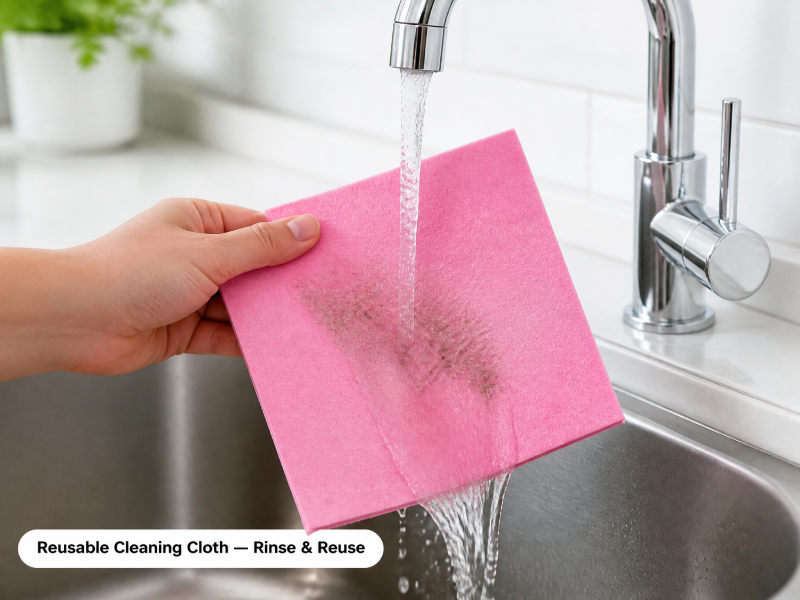
Some products can be rinsed with clean water after use to remove surface dirt and detergent residue.
However, Easy to Rinse, Washable, and Machine Washable do not mean exactly the same thing.
Rinsing mainly indicates whether a product can be cleaned conveniently. Long-term machine washing involves repeated mechanical action, detergent exposure, and drying processes.
If buyers require a product for long-term machine washing, separate testing under the corresponding conditions is necessary.
Similarly, passing an ordinary washing test does not automatically prove that a product is suitable for high-temperature disinfection or industrial cleaning.
Include Test Requirements in Purchasing Documents
For long-term cooperation or large-volume orders, buyers should document the mutually agreed washing conditions and acceptance requirements in the product specification sheet, sample approval document, or purchasing technical agreement.
This helps reduce disputes caused by different washing methods, different testing cycles, or inconsistent acceptance criteria.
What Information Should Buyers Provide Before Purchasing Reusable Cleaning Cloths from JHC?
For overseas buyers sourcing washable cleaning cloths, heavy duty cleaning cloths, or other needle-punched nonwoven cleaning materials, providing clear application and testing requirements can help suppliers evaluate suitable product options more accurately.
HuiZhou JinHaoCheng Nonwovens Co., Ltd. provides needle-punched nonwoven cleaning cloths and related customized product options. The existing reusable cleaning cloth product page lists polyester, viscose, bamboo fibers, and customized fiber blends, together with customization options for GSM, thickness, dimensions, colors, and packaging.
When requesting a quotation or samples, buyers are advised to provide the following information:
Purchasing Information | Details to Provide |
Intended application | Household cleaning, commercial cleaning, industrial wiping, or another use |
Material requirements | Polyester, viscose, bamboo fibers, or a specified blend ratio |
GSM | Target fabric weight |
Thickness | Required thickness and acceptable tolerance |
Dimensions | Finished size or roll specifications |
Absorbency requirements | Whether absorption speed, absorption capacity, or liquid retention is the priority |
Washing method | Hand washing, machine washing, or another cleaning method |
Washing temperature | Intended washing temperature |
Detergent | Actual washing product to be used |
Wash cycles | Number of washing stages to be evaluated |
Drying method | Air drying, hanging, or tumble drying |
Packaging requirements | Individual sheets, bulk packs, rolls, or customized packaging |
Order plan | Sample quantity, initial order quantity, and expected future demand |
If buyers have specific wash durability requirements, they should communicate them during the sample stage rather than waiting until after bulk production to request supporting evidence.
For long-term purchasing projects, it is better to agree on the test conditions first and then evaluate samples using the same method.
This makes it easier to compare different products and establish clearer specifications for future bulk production.
Conclusion: Do Not Just Ask How Many Times a Cleaning Cloth Can Be Washed
The suitability of a cleaning cloth for repeated use cannot be determined only by its initial absorbency, GSM, or marketing claims.
A meaningful wash durability evaluation should examine how absorbency, dimensional stability, edge condition, fiber shedding, surface structure, and hand feel change after different washing stages under clearly defined conditions.
For overseas buyers, the most important thing is not to obtain an unsupported promise about a fixed number of wash cycles. It is to establish a testing method and acceptance criteria that both the buyer and supplier can agree on.
Testing samples, recording changes, and confirming specifications before bulk purchasing provide a more reliable way to determine whether a reusable cleaning cloth meets the actual requirements of the target market.