
SAP Nonwoven vs. Conventional Absorbent Nonwoven: Understanding the Material Differences
When a material needs to absorb a large amount of liquid, buyers often focus on absorption capacity, absorption speed, and liquid retention. However, these performance indicators may be based on very different material mechanisms.
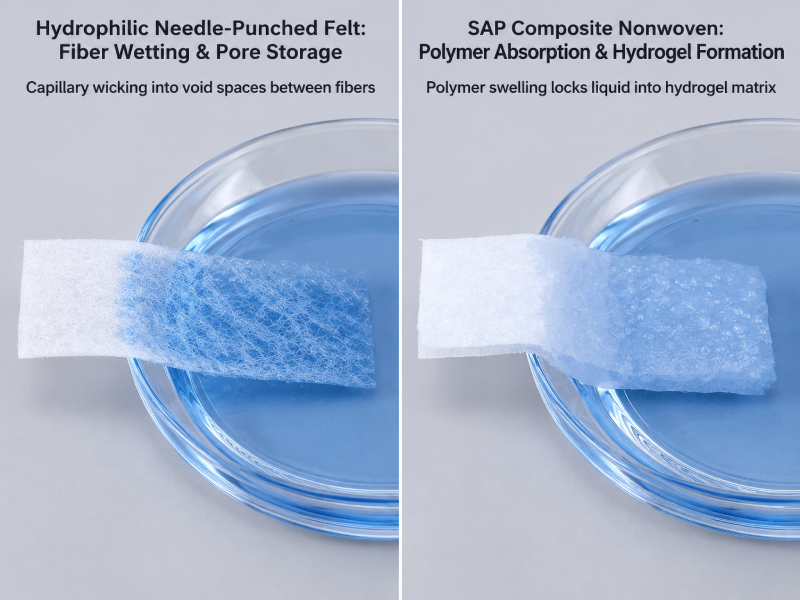
For example, conventional hydrophilic fiber needle-punched absorbent felt mainly relies on fiber affinity for liquid and the pores within its fiber network to absorb, distribute, and temporarily hold liquid. By contrast, a composite nonwoven containing superabsorbent polymer (SAP) can absorb liquid through SAP particles that swell and form a hydrogel.
Both materials can be used to develop absorbent products, but this does not mean that SAP nonwoven is always the better choice. Buyers need to understand the required absorption performance, liquid retention, and material structure of the final product before deciding which material is more suitable.
This guide compares SAP composite nonwoven and conventional hydrophilic fiber absorbent nonwoven in terms of absorption mechanisms, material structure, liquid retention, disposable and reusable applications, and sample testing. It helps buyers make more informed material selection decisions during product development and supplier communication.
What Is SAP Nonwoven Material?
SAP stands for Super Absorbent Polymer, also known as a superabsorbent material. It can absorb liquid and swell to form a hydrogel.
Unlike conventional nonwoven materials that rely mainly on fiber structures to absorb liquid, SAP provides absorption functionality through the swelling properties of the polymer itself.
In composite nonwoven materials, SAP can be combined with a nonwoven fiber carrier to create a material that integrates the supporting structure of the fiber carrier with the liquid absorption function of the polymer. Needle-punched nonwoven can be considered as one possible carrier material, depending on the product development requirements.
For material buyers, it is important to distinguish between two things: SAP raw material has superabsorbent properties, but this does not mean that every nonwoven containing SAP will automatically deliver the same absorption performance. The final performance also depends on the SAP type, actual content, distribution method, carrier structure, and liquid contact conditions.
For example, some buyers may need rolls for subsequent die cutting, while others may require sheets or absorbent materials in specific shapes. Different products have different requirements for thickness, flexibility, swelling space, wet-state structure, and processing methods.
Therefore, when sourcing SAP absorbent material, buyers should not focus only on whether the material contains SAP. They should also understand how SAP is combined with the fiber carrier and whether the resulting structure is suitable for the final product.
What Is Conventional Hydrophilic Absorbent Nonwoven?
Conventional hydrophilic absorbent nonwoven refers to nonwoven materials that mainly rely on the hydrophilic properties of their fibers and the fiber network structure to absorb liquid.
Take conventional needle-punched absorbent felt as an example. The material is produced through a needle-punching process that entangles fibers to form a three-dimensional fiber network with a certain thickness and pore structure.
When liquid comes into contact with the material surface, hydrophilic fibers help the liquid wet the material and enter its internal structure. At the same time, the pores between fibers and capillary action help the liquid move through the material and remain temporarily within the fiber network.
This means that the absorption performance of conventional absorbent felt depends not only on whether the fibers are hydrophilic, but also on fiber composition, fiber fineness, GSM, thickness, density, pore structure, and surface treatment.
For example, viscose and cotton fibers have good hydrophilic properties, while polyester itself has relatively low water absorption. In needle-punched felt made mainly from polyester, liquid is more likely to enter and remain within the spaces between fibers. Different fiber combinations and material structures can therefore produce different absorption results.
One characteristic of conventional needle-punched absorbent felt is that its absorption and liquid storage mainly depend on the fiber network rather than the formation of a SAP hydrogel. As a result, conventional absorbent felt may be more suitable for some products that require a stable fiber structure, further processing, or consideration of reusable applications.
Buyers who want to learn more about conventional materials can refer to conventional needle punched absorbent felt and the technical guide on factors affecting needle punched felt water absorption.
How Do SAP and Conventional Absorbent Nonwovens Absorb Liquid Differently?
The most important difference between these two materials is how they absorb and store liquid.
Conventional hydrophilic fiber absorbent nonwoven mainly relies on fiber wetting, capillary action, and the pores between fibers. SAP composite nonwoven adds another absorption mechanism: the absorption and swelling of superabsorbent polymer within the fiber carrier.
Conventional hydrophilic fiber materials: fiber wetting and pore-based liquid storage
When water or another suitable liquid comes into contact with hydrophilic fibers, it can wet the fiber surfaces and spread through the fiber network.
The internal pores provide temporary storage space for liquid. The connections between fibers and the distribution of pores affect how quickly liquid enters the material, how far it spreads, and how much liquid the material can temporarily hold.
Therefore, the performance of conventional needle-punched absorbent felt is closely related to its fiber type and overall structure. Even when two materials have the same GSM, differences in fiber composition, thickness, or pore structure can result in different absorption performance.
SAP composite nonwoven: polymer absorption and hydrogel formation
When SAP comes into contact with a suitable liquid, it absorbs the liquid and gradually swells to form a hydrogel. Liquid does not simply enter the spaces between fibers; it is also absorbed into the polymer structure.
In SAP composite nonwoven, the fiber carrier and SAP perform different functions. SAP provides the superabsorbent polymer functionality, while the fiber carrier forms the supporting structure of the composite material.
However, SAP absorption performance is affected by liquid composition. Salts and other dissolved substances in different liquids may change the absorption performance of SAP. Therefore, test results obtained with clean water cannot automatically represent how the material will perform in saline solutions or other liquids encountered in actual applications.
The two mechanisms cannot be compared using a single indicator
Pore-based liquid storage in conventional fiber materials and hydrogel absorption by SAP are different mechanisms. Even though both materials can absorb liquid, neither the material name nor a single absorption value is enough to determine which one is more suitable for every application.
Buyers should consider absorption speed, total absorption capacity, liquid retention under pressure, wet-state structure, and actual application conditions together.
What Are the Differences in Gel Formation, Liquid Retention, and Material Structure?
The differences between SAP and conventional absorbent nonwoven are not limited to their absorption mechanisms. They also affect the material's condition and structure after absorbing liquid.
Material condition after liquid absorption
After conventional hydrophilic fiber absorbent felt absorbs liquid, the liquid is mainly distributed over the fiber surfaces and within the fiber network. The material becomes heavier in its wet state, but ordinary fiber absorption does not cause it to form a SAP hydrogel.
After SAP absorbs liquid, it swells and forms a hydrogel. As absorption increases, the material may undergo noticeable volume changes. Therefore, the composite structure needs to provide sufficient space for SAP swelling.
Liquid retention capability
Conventional absorbent felt can temporarily hold liquid through its fiber network and pores. However, some of the liquid may be released from the pores when external pressure is applied.
The hydrogel formed by SAP can retain liquid within the polymer structure, but this does not mean that liquid will never be released under pressure. Actual retention performance still depends on the SAP type, liquid composition, swelling condition, and external pressure.
Therefore, if the final product needs to retain liquid under compression, buyers should ask suppliers to evaluate the material under actual application conditions rather than comparing absorption capacity under free-swelling conditions alone.
Material structure and wet-state stability
For conventional needle-punched absorbent felt, important considerations include fiber entanglement, thickness, density, and wet-state strength.
In addition to the fiber carrier structure, SAP composite nonwoven requires attention to SAP distribution and retention within the material, available swelling space, and whether particle migration, leakage, delamination, or structural damage occurs under wet conditions.
These issues cannot be determined solely from the absorption properties of the SAP raw material. The composite material must be evaluated through its actual structure and physical samples.
For products requiring continuous processing, die cutting, or further lamination, buyers should also confirm whether the material meets the processing and application requirements in both dry and wet conditions.
How Do Disposable and Reusable Products Affect Material Selection?
Whether a product is designed for single use or repeated use directly affects material selection.
Disposable absorbent products
Disposable products generally focus on absorption capacity, absorption speed, liquid retention, and structural integrity during a single use.
For example, some hygiene products, disposable absorbent pads, and other liquid management products may require SAP or SAP composite materials to meet higher absorption and liquid retention requirements.
However, whether SAP is suitable still depends on the final product structure, SAP retention method, absorption speed, swelling space, and wet-state stability.
If the product will be compressed during use, buyers should also test liquid retention under pressure rather than relying only on absorption data obtained without external pressure.
Reusable absorbent products
Reusable products require consideration of material structure and performance after repeated use.
For example, washing, squeezing, drying, and repeated absorption may all affect the material's condition. Conventional needle-punched absorbent felt may offer a more suitable fiber structure and processing option for certain washable or reusable products.
However, a material should not be considered reusable simply because it is conventional absorbent felt. Its fiber composition, wet-state strength, washing conditions, drying method, and performance after repeated use must also be evaluated.
Similarly, SAP composite materials should not be described as reusable or capable of maintaining their original absorption performance over multiple cycles without appropriate cycle testing.
Therefore, buyers should define the intended product service life before selecting a material. For products designed for a single absorption task, the main considerations may be single-use absorption and liquid retention. For products requiring washing or repeated use, durability and structural stability after repeated cycles should also be included in the evaluation.
Which Material Is More Suitable for Different Applications?
No single absorbent nonwoven material is suitable for every application. SAP composite nonwoven and conventional hydrophilic fiber absorbent felt each have their own suitable conditions.
Hygiene products and disposable absorbent products
If a product requires high liquid absorption capacity and improved liquid retention within the material, SAP composite nonwoven can be included in the material development evaluation.
However, its suitability still needs to be assessed based on the final product structure, SAP retention method, absorption speed, liquid retention under pressure, wet-state stability, and applicable product safety and regulatory requirements in the target market.
The presence of SAP alone does not mean that a material can be used directly as a complete absorbent core or finished medical care product.
Agricultural and horticultural water retention materials
In applications such as seedling cultivation, transplanting, and root-zone moisture management, buyers may want a material that can temporarily store water after absorption.
SAP composite nonwoven can be considered as a material development option, but its performance needs to be evaluated under actual irrigation water conditions, including SAP swelling behavior, soil environment, wet-dry cycles, and plant suitability.
At the same time, the amount of water absorbed by SAP does not necessarily equal the amount of water available for plant uptake. Whether the material is suitable for long-term soil contact must also be confirmed based on the specific raw materials and application conditions.
Industrial absorbent and liquid management products
For industrial absorbent products, buyers should first define the liquid type, required absorption speed, target absorption capacity, and whether external pressure will be applied.
If the product mainly requires fiber materials to absorb and temporarily hold liquid, conventional needle-punched absorbent felt may already meet the requirements.
If the product needs the hydrogel-forming mechanism of SAP, SAP composite material can be evaluated further. However, buyers must confirm whether the specific SAP is suitable for the target liquid and whether the wet-state structure meets the application requirements.
Packaging and other absorbent components
For absorbent packaging pads and other composite absorbent components, material selection also needs to consider finished-product thickness, cutting dimensions, liquid distribution, edge structure, and further processing methods.
If the product is intended for food contact, buyers must also confirm the applicable food-contact regulations and test documentation for both the raw materials and the finished product. Absorption capability alone does not demonstrate food-contact compliance.
For these applications, buyers should select materials based on the actual structure and operating conditions of the final product rather than simply pursuing higher absorption figures.
How Should Buyers Compare Samples Before Choosing a Material?
Before choosing SAP composite nonwoven or conventional absorbent nonwoven, buyers should prepare information about the actual application and then compare samples under relevant test conditions.
Step 1: Define the liquid type and application conditions
First, tell the supplier what type of liquid the material will contact, such as clean water, saline solution, cleaning liquid, or another specific liquid.
If the liquid contains salts, dissolved substances, or other components, provide an actual liquid sample or clarify its composition whenever possible. Liquid composition may change the absorption performance of the material, especially the absorption performance of SAP.
At the same time, explain how the liquid will reach the material, such as through immersion, dripping, spraying, or one-sided contact, and whether the material will be exposed to compression.
Step 2: Define the performance requirements that matter
Buyers should distinguish between the following performance indicators:
Absorption speed: How quickly the material needs to absorb liquid.
Absorption capacity: How much liquid the material can absorb under specified conditions.
Liquid retention: How much liquid the material can retain after absorption over a defined period or under external pressure.
Swelling behavior: How the volume and thickness of SAP-containing material change after liquid absorption.
Wet-state structural stability: Whether the material experiences deformation, delamination, powder loss, particle migration, or other structural problems after absorbing liquid.
These indicators cannot replace one another. In particular, free absorption capacity and liquid retention under pressure should be evaluated as separate performance items.
Step 3: Compare samples under the same conditions
If buyers need to compare SAP composite nonwoven with conventional absorbent felt, they should keep sample dimensions, initial dry weight, liquid type, contact method, test duration, and external pressure as consistent as possible.
During testing, record the weight before and after absorption, the time required for liquid absorption, thickness changes after absorption, and liquid release under compression.
For SAP materials, also observe hydrogel formation, swelling space, possible SAP migration or leakage, and whether the composite structure remains intact in wet conditions.
For conventional absorbent felt, focus on liquid entry speed, internal liquid distribution, wet-state structure, and liquid release under compression.
If test results will be used for formal supplier comparisons, the test methods and evaluation criteria should be agreed upon in advance to avoid misleading conclusions caused by different testing conditions.
Step 4: Validate the material in the final product
Passing basic absorption tests does not automatically mean that a sample is suitable for the final product.
For example, roll materials may need to undergo slitting and further processing. Sheet materials may require specific dimensions and installation methods. Disposable absorbent products need to meet absorption and retention requirements during a single use, while reusable products need to be evaluated for structural changes after washing and repeated use.
If the material needs to be laminated with other layers, buyers should also check the thickness, structural stability, and liquid transfer performance of the finished composite.
Step 5: Finalize material specifications based on test results
After sample testing, buyers can determine the final fiber composition, SAP type, material structure, GSM, thickness, dimensions, and supply format.
If conventional absorbent felt already meets the target performance requirements, there may be no need to introduce the additional complexity of a SAP composite material simply to use a superabsorbent material.
If the conventional fiber structure cannot meet the required absorption and liquid retention performance, buyers can further develop SAP composite nonwoven and verify its actual performance through sample evaluation.
For buyers, the most suitable material is not necessarily the one with the highest absorption capacity. It is the material that meets the actual application requirements and is suitable for further processing and bulk purchasing.
Conclusion: Select Materials Based on Absorption Mechanisms and Final Applications
The key difference between SAP composite nonwoven and conventional hydrophilic fiber absorbent nonwoven lies in their liquid storage mechanisms. Conventional absorbent felt mainly relies on hydrophilic fibers and pores within the fiber network to absorb, distribute, and temporarily hold liquid. SAP composite material uses superabsorbent polymer to absorb liquid and form a hydrogel.
If a product requires high liquid absorption and retention, SAP composite nonwoven can be evaluated. If a conventional fiber structure already meets the absorption requirements, conventional needle-punched absorbent felt may be a more suitable choice.
For material buyers, the final decision should be based on liquid type, actual application conditions, sample testing, and finished-product validation rather than material names or a single absorption figure.
If you are developing SAP absorbent materials or conventional needle-punched absorbent felt, provide your material supplier with the target application, liquid type, absorption requirements, material dimensions, and operating conditions. This information can help evaluate a suitable material structure and sample development plan.




