
Thermal Bonded Wadding for Bedding: How Does It Work in Quilts, Comforters and Mattresses?
Thermal bonded wadding is widely used as a filling, cushioning, or padding material in bedding products. It can help manufacturers achieve the required loft, softness, thickness, and structure in quilts, comforters, mattresses, and selected pillow constructions.
However, choosing the right thermal bonded wadding for bedding involves more than selecting a GSM value. Different bedding products have different structural requirements. A filling layer for a lightweight quilt may need a different thickness and resilience from a padding layer used in a mattress.
For bedding manufacturers and material buyers, understanding how wadding performs in different product structures is essential before confirming material specifications, requesting samples, or placing bulk orders.
Why Do Bedding Manufacturers Use Thermal Bonded Wadding?
Bedding manufacturers use thermal bonded wadding because it provides a nonwoven filling structure that can be supplied in rolls or sheets and processed according to different product requirements.
In quilts and comforters, it is commonly used to provide filling volume and a soft, padded feel. In mattresses, it can serve as a cushioning, padding, or covering layer within the overall construction. In selected pillow designs, it can be used as a sheet-form filling or wrapping layer.
The performance of polyester wadding for bedding depends on several factors, including fiber composition, GSM, thickness, web structure, and bonding conditions. These factors influence the material's loft, softness, resilience, and overall consistency.
For manufacturers, the main advantage is the ability to select and customize material specifications according to the intended application rather than using one specification for every bedding product.
How Is Thermal Bonded Wadding Used in Quilts and Comforters?
In quilts and comforters, thermal bonded wadding is mainly used as the internal filling layer. It helps create the volume and padded structure between the outer fabric layers.
When selecting nonwoven batting for comforters, manufacturers should consider the finished product's required weight, loft, softness, and quilting construction.
A lightweight quilt may require a different filling specification from a thicker comforter designed to provide more volume. The wadding must also be suitable for the intended quilting process. Its thickness, fiber structure, and consistency can affect how it is handled and secured during production.
The following factors should be considered when selecting wadding for quilts and comforters:
Selection Factor | What Manufacturers Should Consider |
GSM | The weight of the filling layer and its contribution to the finished product |
Thickness | The required filling volume and overall loft |
Softness | The hand feel and comfort expected from the finished quilt or comforter |
Resilience | Whether the material can recover after compression |
Fiber composition | How the fiber blend affects the material's structure and performance |
Quilting compatibility | Whether the wadding is suitable for the intended quilting pattern and production process |
GSM alone cannot determine the final comfort or appearance of a quilt. Two materials with the same GSM may have different thicknesses, softness, and resilience because of differences in fiber composition and material structure.
Therefore, buyers should evaluate samples using the actual fabric and quilting construction whenever possible.
What Role Does Wadding Play in Mattress Construction?
In mattress manufacturing, thermal bonded wadding is generally used as a filling, cushioning, or covering layer within the mattress structure.
It can be placed alongside other materials, such as foam or spring systems, depending on the mattress design. Its role is to provide an additional padding layer and contribute to the overall surface structure.
However, thermal bonded wadding should not automatically be treated as the main load-bearing component of a mattress. The mattress's primary support function is generally provided by its core structure, such as foam or springs. Wadding serves a different purpose within the overall construction.
When sourcing mattress wadding, manufacturers should consider the position of the material in the mattress and the requirements of the surrounding layers.
For example, a padding layer used near the mattress surface may have different softness and thickness requirements from a layer used for internal covering or cushioning.
Before selecting a specification, buyers should confirm the intended position of the wadding, the required thickness, the material's compression and recovery characteristics, and its compatibility with the other mattress components.
Can Thermal Bonded Wadding Be Used in Pillows?
Thermal bonded wadding can be used in selected pillow constructions, but buyers need to distinguish between sheet-form wadding and loose fiber filling.
Sheet-form wadding can serve as an internal padding layer or wrapping layer in certain pillow designs. It provides a structured layer that can be cut and processed according to the pillow's construction.
However, this is different from loose polyester fiber used as the main filling inside many conventional pillows. Roll-form or sheet-form thermal bonded wadding should not be described as loose fiber filling.
When sourcing wadding for pillow production, manufacturers should first confirm the required material format and its position in the finished product.
They should also evaluate the material's thickness, softness, loft, and resilience to ensure that it is suitable for the intended pillow structure.
How Do Loft and Thickness Affect Bedding Products?
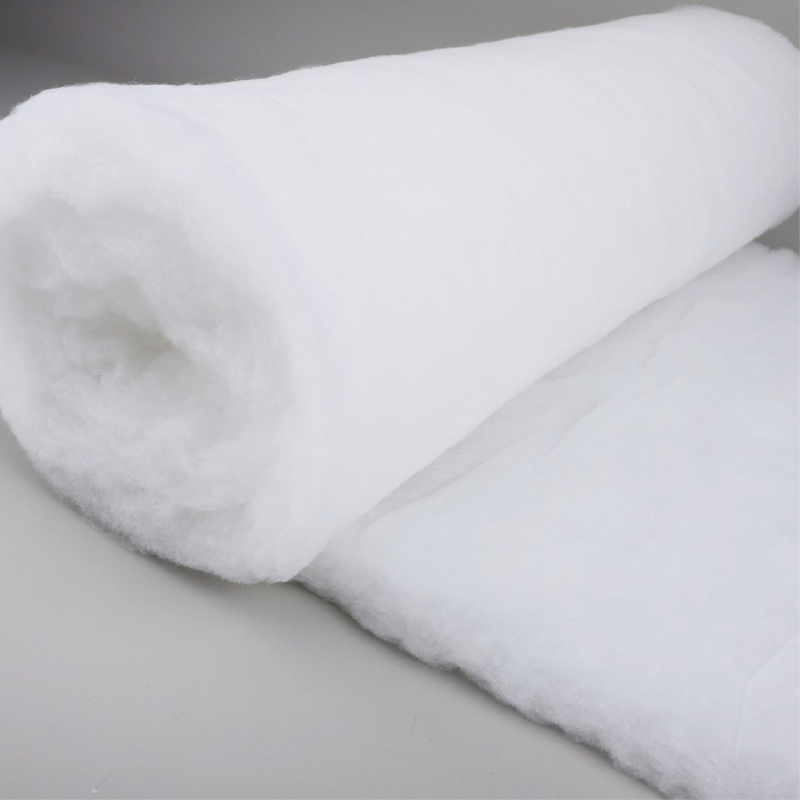
Loft and thickness are important factors when selecting thermal bonded wadding for bedding. They influence the filling volume, appearance, and feel of the finished product.
For quilts and comforters, loft contributes to the product's overall volume and padded appearance. For mattress padding, thickness affects the structure of the cushioning layer. For sheet-form pillow applications, loft and thickness influence the amount of padding provided by the material.
However, thickness and GSM are not interchangeable measurements.
GSM indicates the weight of the material per square meter, while thickness describes the distance between its two surfaces under specified measurement conditions. A higher GSM does not necessarily mean that the material will have greater loft.
The final thickness and loft can also be affected by fiber composition, web structure, bonding conditions, and compression during storage or processing.
For this reason, buyers should confirm both GSM and thickness instead of using GSM as the only purchasing specification.
How Should Buyers Evaluate Softness and Resilience?
Softness and resilience are two different properties that should be evaluated separately when purchasing thermal bonded wadding for bedding.
Softness relates to how the material feels when touched or compressed. It can influence the hand feel of quilts, comforters, and padding layers.
Resilience refers to the material's ability to recover after compression. It is relevant when the filling layer may be compressed during production, packaging, transportation, or use.
A material can feel soft but may not recover well after compression. Likewise, a material with good recovery may not necessarily have the softness required for a particular bedding product.
Buyers should evaluate samples based on the actual application rather than relying only on a product description or GSM value.
Important evaluation points include thickness consistency, surface uniformity, hand feel, loft, compression recovery, and fiber stability.
If the finished bedding product will be washed, washing performance should also be evaluated using a sample that reflects the actual product construction and intended care conditions. Buyers should check whether the filling structure changes, becomes uneven, or develops fiber migration after washing.
For more information about material consistency and performance, buyers can refer to our guide on thermal bonded wadding quality and resilience and the article about thermal bonded wadding fiber migration after washing.
How Should Buyers Select GSM and Fiber Composition?
GSM and fiber composition are two important specifications when sourcing thermal bonded wadding for bedding. However, they should be selected according to the finished product's requirements rather than independently.
GSM determines the material's weight per square meter, while fiber composition influences its structure, softness, loft, and resilience.
For example, a quilt filling layer and a mattress padding layer may require different combinations of weight, thickness, and material properties. Buyers should not assume that the same GSM and fiber composition will work equally well for every bedding application.
Before requesting a quotation, manufacturers should clarify the following specifications:
Specification | Information to Confirm |
Fiber Composition | Polyester or other required fiber blends |
GSM | Target weight per square meter |
Thickness | Required material thickness |
Density | Required material structure or density, where applicable |
Softness | Expected hand feel |
Loft | Required filling volume |
Resilience | Expected compression recovery |
Width | Required roll or sheet width |
Application | Quilt, comforter, mattress padding, or pillow construction |
Buyers who are still comparing material options can also refer to our guides on different types of thermal bonded wadding and thermal bonded wadding GSM and roll weight calculation.
The final specification should be confirmed through sample evaluation. A material that meets the target GSM may still need adjustment in thickness, softness, or fiber composition to match the finished product requirements.
What Supply and Sample Details Should Bedding Buyers Confirm?
Before placing a bulk order, bedding manufacturers should confirm not only the material specifications but also the supply format and processing requirements.
Thermal bonded wadding can be supplied in rolls or sheets, depending on the production process and the buyer's requirements. The required width, thickness, GSM, and material format should be clearly communicated before sampling.
Buyers should also explain whether the material will be used for quilting, cutting, lamination, or another converting process. These details help determine whether the sample is suitable for the intended production line.
During sample evaluation, manufacturers should check the material's thickness, softness, loft, resilience, uniformity, and fiber stability. If washing performance is important, the sample should be tested under conditions that reflect the intended finished product.
Before confirming a bulk order, both parties should agree on the material specifications, approved sample, processing requirements, packaging, labeling, and inspection standards.
As a manufacturer of nonwoven materials, HuiZhou JinHaoCheng Nonwovens Co., Ltd. can discuss customized thermal bonded wadding specifications according to different bedding applications. Buyers should provide their target GSM, thickness, width, fiber composition, application, and sample requirements so that the material can be evaluated against the actual production needs.
A clear specification and an approved sample help reduce misunderstandings and improve consistency between sample approval and bulk production.




