Why Must Welding Fire Resistant Felt Use Flame Retardant Materials? 6 Key Points Buyers Should Check
In welding, cutting, grinding, and other metalworking environments, sparks, hot metal particles, and intense heat can land on floors, equipment, pipes, walls, or other surfaces that need protection. For this reason, when purchasing welding protection mats, welding fire mats, or welding blanket materials, many industrial buyers are not only concerned about price. They also ask a very practical question:
Can ordinary heat resistant felt really be used for welding protection? Why does welding fire resistant felt need to use flame retardant materials?
The answer is not simply “the higher the heat resistance, the better.”
Welding protection materials need to deal with more than high temperature. They may be exposed to flying sparks, molten metal particles, short-term flame contact, radiant heat, and repeated heating during continuous welding operations. Therefore, flame retardancy, heat resistance, structural stability, and actual operating conditions all need to be considered together.
For importers, wholesalers, industrial protection brands, and welding product suppliers, choosing a product only by price or material thickness can lead to problems such as burning through, continued combustion, deformation, fiber shedding, or inconsistent performance between batches.
Therefore, when purchasing needle punched fire resistant felt, the more important question is whether the material is genuinely suitable for the intended welding protection application.
Why Can't Welding Fire Resistant Felt Be Selected by Heat Resistance Alone?
Many buyers see heat resistant felt or high temperature resistant felt and assume that any material capable of withstanding high temperatures can be used for welding protection.
In reality, the performance requirements are not exactly the same.
Heat resistance mainly concerns whether a material can maintain its basic structure and performance under a certain temperature condition. Flame retardancy, on the other hand, focuses more on how the material behaves when exposed to flame or a heat source, including whether it continues to burn and whether it can self-extinguish under specified test conditions.
The most typical problem in welding is not that the material remains at one fixed temperature for a long period. Instead, the material may experience:
Welding sparks suddenly landing on the surface;
Hot molten metal droplets making short-term contact;
Intense radiant heat affecting a localized area;
Direct contact between the material edge or surface and a flame;
Continuous local heating during extended welding operations.
Therefore, even if a material has a certain level of heat resistance, this does not automatically mean that it is suitable as a welding fire mat or welding blanket material.
For welding protection applications, flame retardancy and heat resistance should be considered together rather than evaluating only one of them.
What Risks Can Ordinary Materials Face During Welding?
Welding produces sparks and molten metal particles with high instantaneous thermal energy.
If ordinary fiber materials are used as a floor or equipment protection layer, hot particles landing on the surface may cause localized scorching, melting, shrinkage, continued burning, or holes in the material.
This is why industrial buyers purchasing welding floor protection mats should not compare products only by:
Material thickness;
GSM;
Price per kilogram;
Roll length.
These specifications are important, but they cannot independently prove that a material provides sufficient welding protection.
For large engineering projects, shipbuilding, automotive manufacturing, metalworking facilities, and construction sites, unstable material performance can affect the entire working process.
Therefore, for welding protection products, the flame-retardant structure and actual test performance of the material are more important than simply increasing material thickness.
Why Are Flame Retardant Materials More Suitable for Welding Protection?
The main value of flame retardant materials is that they can reduce the risk of continued combustion when exposed to flame or high-temperature heat sources.
A properly designed flame retardant felt can be developed through a combination of fiber selection, flame-retardant treatment, material structure, and manufacturing processes to achieve performance suitable for specific protection applications.
For needle punched fire resistant felt, the needle punching process can create a relatively stable three-dimensional fiber structure. Manufacturers can also adjust the material according to application requirements, including:
Fiber composition
GSM
Thickness
Density
Needle punching density
Flame retardant grade
Color and dimensions
Different welding environments have different requirements, so there is no single specification suitable for every welding application.
What buyers really need to confirm is:
“Has this material been tested for the intended application?”
rather than simply asking:
“Is this material fireproof?”
What Core Performance Should Welding Fire Resistant Felt Have?
If you are purchasing fireproof nonwoven felt or welding protection materials, do not simply ask a supplier whether the product is flame retardant. It is better to evaluate the following performance factors.
1. Flame Retardancy
This is one of the fundamental properties of welding fire resistant felt.
Different materials may have different flame-retardant grades and test results. Buyers should confirm the relevant testing requirements according to the target market, application environment, and final product requirements.
It is particularly important to understand that “flame retardant” does not mean “the material can never burn under any conditions.”
Actual performance depends on fiber type, thickness, structure, flame-retardant system, and test method. Therefore, specific test data from the supplier is more useful than simply describing a product as “fireproof.”
2. Heat Resistance
Welding protection materials not only need to reduce combustion risks but also need to maintain a certain level of structural stability during short-term exposure to high temperatures.
Therefore, heat resistant felt, thermal protection felt, and fire resistant felt may have overlapping applications, but they are not exactly the same.
Before purchasing, buyers should clarify whether the material will be exposed to:
Short-term sparks;
Hot molten metal;
Continuous heat sources;
Or long-term high-temperature environments.
Different working conditions require different material solutions.
3. Resistance to Burn-Through
For welding floor protection, buyers should not consider only whether the surface is flame retardant.
If high-temperature molten metal repeatedly lands in the same area, the material may also need suitable thickness and structure to reduce the risk of rapid localized burn-through.
Therefore, GSM, thickness, density, and fiber structure can all affect the final protection performance.
This is why professional needle punched nonwoven manufacturers usually adjust material specifications according to the application instead of supplying the same standard thickness to every customer.
4. Structural Stability
Welding fire resistant felt may need to be repeatedly installed, folded, transported, and cut at the worksite.
If the material structure is too loose, it may experience fiber shedding, loose edges, or localized deformation.
For long-term welding protection mats, a stable needle punched structure can help improve the overall stability of the material during transportation, processing, and actual use.
5. Consistency of Size and Thickness
For bulk purchasing, an approved sample does not necessarily mean that the entire production batch will remain consistent.
If significant variations occur in GSM, thickness, width, or density between batches, the performance of the final welding protection product may also change.
Therefore, for fire resistant felt wholesale projects, batch-to-batch consistency is an important purchasing consideration.
6. Actual Operating Environment
A welding protection felt is not an independent material that can be evaluated without considering its application environment.
Before purchasing, buyers should determine whether the material will be used in:
Factory welding areas;
Construction sites;
Shipbuilding and ship repair;
Automotive manufacturing;
Metal processing;
Pipe welding;
Equipment maintenance;
Or temporary floor protection.
Different applications may require different levels of flexibility, thickness, heat resistance, flame retardancy, dimensions, and processing performance.
Can Standard Needle Punched Felt Replace Welding Fire Resistant Felt?
It should not be assumed that standard needle punched felt can directly replace welding fire resistant felt.
Standard needle punched felt may be designed primarily for insulation, sound absorption, filtration, cushioning, or other industrial applications. It is not necessarily optimized for flame exposure and welding spark protection.
In contrast, flame retardant felt and needle punched fire resistant felt are designed with flame exposure, high-temperature particles, or heat sources among their important application considerations.
This does not mean that standard needle punched felt has no heat resistance. Rather:
Standard needle punched felt ≠ specially designed flame retardant welding protection felt.
If the final product will be used for welding protection, buyers should clearly communicate the application to the supplier instead of simply asking for “a thicker needle punched felt.”
Once the application is clear, the manufacturer can evaluate suitable options such as fire resistant fiber felt, flame retardant polyester felt, blended fiber nonwoven felt, or other material solutions.
Can Different Flame Retardant Fibers Be Used for Welding Fire Resistant Felt?
Different fibers have different flame-retardant and heat-resistant characteristics. Therefore, no single fiber should be considered automatically suitable for every welding application.
Common material options may include:
Flame Retardant Polyester Fiber
Suitable for some applications that require a balance of flame retardancy, flexibility, and processing performance.
Blended Flame Retardant Fiber Materials
Different fibers can be combined to balance flame retardancy, strength, softness, and cost according to the target performance.
Flame Resistant Wool Felt
Wool has certain natural flame-resistant characteristics and can be considered for some protection and industrial applications.
Oxidized PAN Fiber Felt
Oxidized PAN fiber provides good high-temperature and flame-resistant characteristics and can be used for more specialized high-temperature protection and insulation applications.
Carbon Fiber Felt
Carbon fiber felt is suitable for specific high-temperature insulation environments, but actual working temperature, operating atmosphere, and oxidation conditions need to be carefully considered.
Therefore, buyers should not simply ask:
“Which material is the most fire resistant?”
A more practical question is:
“What flame-retardant and heat-resistant performance does my welding application actually require?”
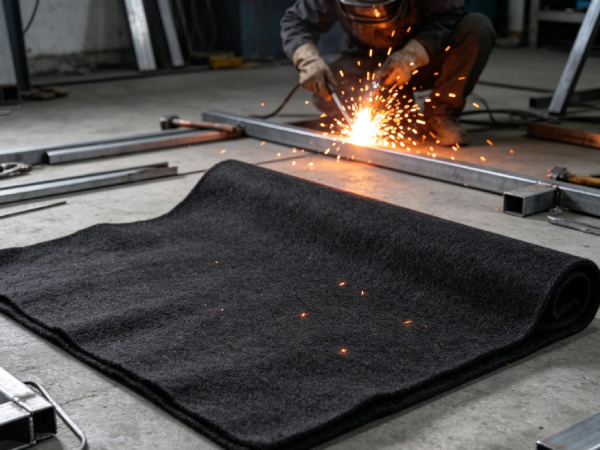
What Products Can Welding Fire Resistant Felt Be Used For?
Depending on the material structure and specific performance, flame retardant needle punched felt can be used in a range of industrial protection products.
Welding Protection Mat
Used for localized protection in welding areas to reduce direct contact between sparks, hot particles, and the protected surface.
Welding Fire Mat
Can be used for localized fire protection in construction sites, maintenance areas, and industrial production environments.
Welding Blanket Material
After cutting and further processing, the material can be used to manufacture welding protection blankets in different sizes.
Welding Floor Protection Mat
Used on floors, around equipment, and in other areas where the impact of welding sparks needs to be reduced.
Fire Blanket Material
Depending on material performance and relevant testing requirements, flame retardant needle punched felt can also be considered as one material option for certain fire blanket products.
However, whether a material is suitable as fire blanket material, fire suppression blanket material, or emergency fire blanket material must be verified according to the final product structure, applicable testing standards, and intended operating environment. It cannot be determined simply by calling the material “flame retardant felt.”
Why Should You Not Compare Welding Fire Resistant Felt by Price Alone?
For importers and wholesalers, price is naturally an important consideration.
However, purchasing only according to “price per kilogram” can cause buyers to overlook several factors that have a real impact on total cost.
For example, a material may have a lower unit price, but if it has:
Unstable thickness;
Large GSM variations;
Inconsistent flame-retardant performance between batches;
Excessive fiber shedding;
Poor dimensional stability;
High dimensional tolerance;
Or high cutting waste;
the overall cost of the finished product may increase.
Therefore, a professional fire resistant felt manufacturer should not simply provide a low quotation. The manufacturer should also help customers establish stable material specifications.
For long-term purchasing, consistency can be more valuable than a lower one-time purchase price.
What Should Buyers Ask Before Purchasing Welding Fire Resistant Felt in Bulk?
If you are looking for a fireproof felt supplier or flame retardant felt manufacturer, it is recommended to confirm at least the following questions before placing an order:
First, what is the fiber composition?
Confirm whether the material uses flame retardant polyester, blended fibers, wool, oxidized PAN, carbon fiber, or another material.
Second, how is the flame-retardant performance tested?
Do not rely only on verbal descriptions such as “fireproof” or “flame retardant.” Ask for relevant testing information.
Third, what are the GSM and thickness?
Confirm the tolerance range and whether the manufacturer can maintain consistency during mass production.
Fourth, what working environment is the material designed for?
In particular, clarify whether the material will face welding sparks, hot molten metal, or continuous heat sources.
Fifth, can the product be customized?
For wholesalers and brand customers, confirm whether the manufacturer can provide different widths, lengths, thicknesses, colors, packaging options, and cutting specifications.
Sixth, can the sample and bulk order remain consistent?
This is especially important for long-term purchasing.
If a supplier cannot clearly answer these questions, even a very low sample price does not necessarily make the supplier a suitable long-term manufacturing partner.
Why Is Choosing a Professional Needle Punched Felt Manufacturer More Important?
The final performance of welding fire resistant felt is not determined by a single specification.
From fiber raw materials, opening, carding, and web formation to needle punching and subsequent processing, every stage can influence the final material structure.
Therefore, for customers requiring stable bulk supply, choosing a professional needle punched felt factory is more important than simply finding the lowest trading quotation.
A professional manufacturer can usually adjust:
Fiber composition
GSM
Thickness
Density
Needle punched structure
Width
Roll length
Cutting dimensions
Packaging
to develop custom fire resistant felt that is better suited to specific welding protection products.
This production flexibility is particularly valuable for OEM customers.
How Does Jinhaocheng Provide Customized Production for Welding Fire Resistant Felt?
HUIZHOU JINHAOCHENG NONWOVENS CO., LTD. has more than 20 years of nonwoven R&D and manufacturing experience. Its production base covers approximately 26,000 square meters and is equipped with 15 automated needle punching production lines, providing large-scale production capacity for needle punched nonwoven felt.
As a professional needle punched felt manufacturer, fire resistant felt manufacturer, and nonwoven felt manufacturer China, Jinhaocheng can provide customized needle punched nonwoven materials according to different application requirements.
For welding protection products, customers can discuss requirements including:
GSM and thickness
Material composition
Flame-retardant performance requirements
Width and roll length
Cutting dimensions
Color
Packaging
OEM / ODM requirements
For wholesalers, importers, and industrial product manufacturers requiring long-term supply, stable production capacity and specification control can help reduce product differences between production batches.
In addition to fire resistant felt and flame retardant nonwoven fabric, Jinhaocheng also manufactures a variety of needle punched nonwoven products and can develop customized materials for different industrial applications.
How Should You Choose Welding Fire Resistant Felt?
If the final product is intended for welding protection, it is not recommended to purchase simply according to the idea that “thicker is always better” or “higher temperature resistance is always better.”
A more practical selection process is:
Identify the application → identify the heat source → confirm flame-retardant requirements → confirm heat-resistance requirements → determine the fiber material → determine GSM and thickness → test the sample → confirm bulk specifications and consistency.
If the main requirement is protection against ordinary welding sparks, buyers can focus on flame retardant felt, fire resistant felt, and welding protection mats.
If higher-level high-temperature protection is required, materials such as oxidized PAN fiber felt, carbon fiber felt, or other high-temperature protection materials may need to be evaluated.
If the product also requires thermal insulation, the performance of thermal insulation felt, heat resistant felt, and thermal protection felt should also be considered.
The final material selection should be based on actual application conditions and testing requirements rather than relying solely on the product name.
Conclusion: Welding Fire Resistant Felt Needs Flame Retardancy, Heat Resistance, and Structural Stability
Welding protection materials are exposed not only to ordinary high temperatures but also to flying sparks, hot molten metal, radiant heat, and short-term or repeated thermal impact.
Therefore, welding fire resistant felt should not be selected simply because it is described as “heat resistant.”
For products such as welding fire mats, welding protection mats, welding blanket materials, and welding floor protection mats, flame-retardant performance is one of the important fundamental properties. At the same time, buyers should consider heat resistance, burn-through resistance, thickness, GSM, structural stability, and batch-to-batch consistency.
For importers, wholesalers, industrial protection brands, and OEM customers, the most important question is not simply “Which supplier offers the lowest price?” but:
Can the manufacturer provide a material suitable for the application?
Can it maintain stable production?
Can it control the specifications of every production batch?
Can it provide OEM and ODM customization according to customer requirements?
Choosing a reliable fire resistant nonwoven manufacturer with stable manufacturing capabilities can make welding protection products more reliable in terms of material selection, specification control, and long-term supply.
If you are looking for a fire resistant felt manufacturer, flame retardant felt manufacturer, fireproof felt supplier, needle punched felt factory, or need custom fire resistant felt / OEM fireproof felt, Jinhaocheng can provide suitable needle punched nonwoven material solutions according to your application requirements.