What Materials Can Fire Resistant Felt Be Laminated With? Which Composite Structures Suit Different Applications?
For importers, wholesalers, distributors, and OEM buyers, one common question when developing composite fire resistant felt is: what materials can be laminated with fire resistant felt?
The answer is not simply about whether two materials can be bonded together. Buyers also need to consider the working temperature, flame exposure, installation position, flexibility, mechanical requirements, and the final product's intended use.
For example, aluminum foil may be selected when radiant heat reflection is important, while fiberglass cloth can provide additional mechanical support and surface stability. In some applications, silicone-coated fiberglass cloth or other high-temperature textiles may be more suitable.
At the same time, functional films such as PE, TPE, PVC, or EVA may be considered for certain composite structures, but their suitability depends on where the layer is located and the temperature and flame conditions it will experience.
Therefore, when purchasing composite fire resistant felt, buyers should not only ask “What can be laminated?” but also “Which composite structure is suitable for my application?”
Why Can't Single-Layer Fire Resistant Felt Always Meet the Final Product Requirements?
A single layer of fire resistant felt can provide flame resistance, heat protection, cushioning, or insulation depending on the fiber composition and product design.
However, some finished products require additional functions that cannot be provided by the felt layer alone.
For example, a product may need to reflect radiant heat, improve surface strength, provide additional moisture resistance, increase dimensional stability, or create a more durable protective surface.
In these situations, adding another functional material through lamination can create a composite structure with different properties.
This is why composite fire resistant felt is often developed according to the requirements of the final application rather than using one standard structure for every product.
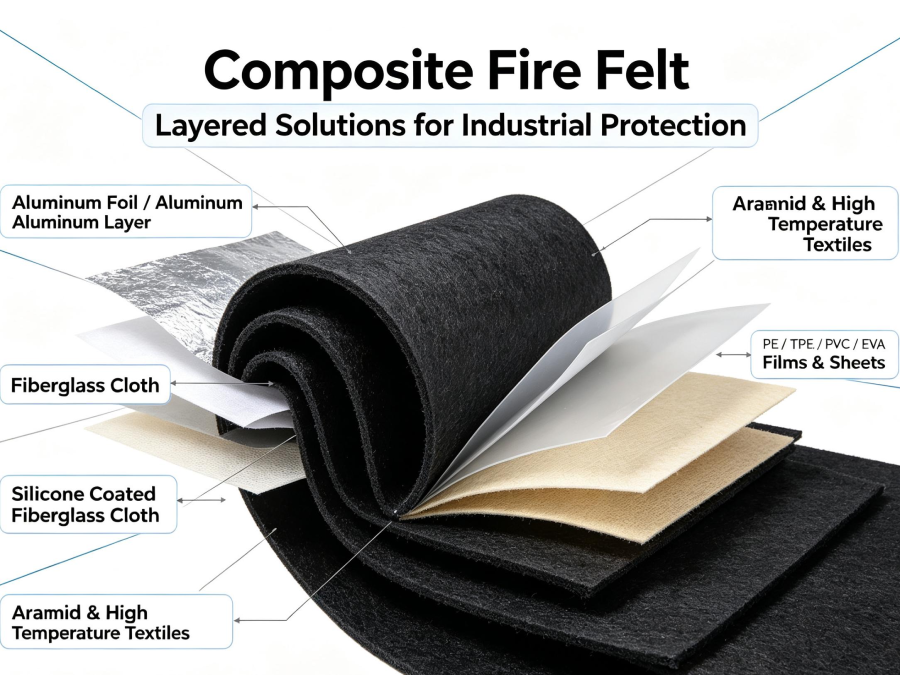
What Materials Are Commonly Laminated with Fire Resistant Felt?
Different materials can be selected according to the intended application and working environment.
Aluminum foil or aluminum layers can be used when radiant heat reflection and thermal shielding are required.
Fiberglass cloth can provide additional mechanical strength, dimensional stability, and surface reinforcement.
Silicone-coated fiberglass cloth can be considered for applications requiring flexibility together with heat, moisture, and surface protection.
Aramid and other high-temperature textiles can be considered for applications with higher requirements for heat resistance, flame exposure, and mechanical performance.
For some applications that do not involve direct high-temperature or direct flame exposure, functional films or sheets such as PE, TPE, PVC, and EVA may also be considered as part of a composite structure.
However, these materials should not automatically be treated as suitable for direct flame or high-temperature exposure. The actual temperature, exposure time, layer position, and complete product structure need to be evaluated before selecting the material.
When Is Aluminum Foil Suitable for Fire Resistant Felt?
Aluminum foil is often considered when the final product needs additional radiant heat reflection, thermal shielding, or surface protection.
The aluminum layer can reflect part of the radiant heat reaching the surface, making it useful in certain thermal protection and insulation structures. Aluminum foil laminated with fiberglass-based materials is also used in applications involving heat shielding and thermal insulation.
When laminated with fire resistant felt, the aluminum layer can therefore serve a different function from the felt itself.
The felt can provide the main fibrous structure, while the aluminum layer can contribute to radiant heat reflection and surface barrier performance.
For buyers developing fire resistant insulation felt, aluminum foil laminated structures may be considered when radiant heat protection is one of the product requirements.
What Does Fiberglass Cloth Add to Composite Fire Resistant Felt?
Fiberglass cloth can provide additional mechanical strength, dimensional stability, and surface reinforcement.
Compared with a soft single-layer felt, adding a textile reinforcement layer can help create a more stable composite structure for products that need to maintain their shape during handling and use.
Fiberglass-based materials are commonly used in heat protection and fire protection composite fabrics because the fiberglass substrate provides mechanical support while maintaining heat-resistant characteristics.
For buyers, fiberglass cloth can therefore be considered when the final product needs more than basic flame-resistant performance and also requires greater structural stability.
The exact fiberglass specification should still be selected according to the application, thickness, weight, flexibility, and required mechanical performance.
Why Is Silicone-Coated Fiberglass Cloth Suitable for Some High-Temperature Protection Products?
Silicone-coated fiberglass cloth combines a fiberglass textile structure with a silicone coating.
This type of material can provide a combination of heat resistance, flexibility, water resistance, abrasion resistance, and surface protection, depending on the specific material construction and formulation.
For some high-temperature protective covers, insulation products, welding protection products, and flexible thermal protection structures, silicone-coated fiberglass cloth can therefore be considered as a functional composite layer.
When combined with fire resistant felt, the two materials can perform different functions within the overall structure.
The fiberglass layer provides structural reinforcement, while the silicone coating can improve surface protection and flexibility.
However, buyers should always confirm the actual working temperature and exposure conditions of the complete composite product rather than judging suitability only from the name of the material.
Can Aramid and Other High-Temperature Textiles Be Laminated with Fire Resistant Felt?
Yes. Aramid and other high-temperature textiles can be considered when the final product has higher requirements for heat resistance, flame exposure, flexibility, or mechanical strength.
Compared with standard textile materials, high-temperature textile layers can provide additional performance for specialized protective applications.
For buyers developing industrial fire protection products, thermal barriers, protective covers, or other high-performance composite materials, the textile layer can be selected according to the actual working conditions.
The important point is that the textile material should match the fire resistant felt and the final application rather than simply being selected because it has a high temperature resistance rating.
Can PE, TPE, PVC, and EVA Be Laminated with Fire Resistant Felt?
In composite processing, functional films or sheets such as PE, TPE, PVC, and EVA can be considered for certain applications.
However, their suitability depends strongly on the working temperature, flame exposure, layer position, and intended function.
For example, these materials may be considered for waterproofing, barrier protection, cushioning, or other functional requirements in applications where the film or sheet is not directly exposed to high temperatures or flames.
They should not automatically be treated as fire-resistant materials simply because they are laminated with fire resistant felt.
For applications involving direct flame, high-temperature exposure, or severe thermal conditions, buyers should evaluate the complete composite structure and confirm whether the selected layer can withstand the actual operating environment.
Why Is “Where the Material Is Laminated” Sometimes More Important Than “What Material Is Laminated”?
When developing composite fire resistant felt, buyers often focus on the material itself.
However, the position of each layer can be equally important.
For example, aluminum foil may be placed on the exposed side when radiant heat reflection is required.
Fiberglass cloth may be positioned where additional mechanical reinforcement and surface stability are needed.
PE or TPE may be considered as a functional backing layer in applications where waterproofing or barrier protection is required and where the backing is not exposed to unsuitable high-temperature conditions.
Therefore, the same material can have different functions depending on where it is placed within the composite structure.
This is why professional fire resistant felt manufacturers need to consider the complete layer structure rather than simply adding as many materials as possible.
Why Can Composite Fire Resistant Felt Develop Delamination?
One common problem with composite materials is delamination between different layers.
If the lamination process is not properly controlled, the finished material may develop edge lifting, bubbles, local separation, or layer peeling during cutting, bending, transportation, installation, or use.
The compatibility between the felt and composite layer, bonding method, lamination conditions, material thickness, and production control can all influence the stability of the finished structure.
For industrial applications, stable bonding is therefore an important part of product quality.
When purchasing composite fire resistant felt, buyers should not only ask which materials are used but also ask how the layers are bonded and how the manufacturer controls batch consistency.
What Information Should Buyers Provide When Purchasing Composite Fire Resistant Felt?
When requesting a quotation or developing a customized product, buyers should provide as much application information as possible.
First, describe the final application and working environment.
Second, provide information about the working temperature and flame or heat exposure.
Third, specify the required composite layer or material, if already determined.
Fourth, provide the required GSM, thickness, density, width, roll length, or finished dimensions.
Finally, explain any required cutting, laminating, die-cutting, sewing, or other downstream processing.
The more accurately the application is described, the easier it is for the manufacturer to recommend a suitable composite structure.
Why Is Composite Fire Resistant Felt Suitable for OEM Customization?
Different applications require different material structures, so OEM and ODM customization can be particularly useful for composite fire resistant felt.
Manufacturers can adjust the fiber composition, GSM, thickness, density, width, roll length, composite material, and layer structure according to the final application.
For example, one project may require fire resistant felt laminated with aluminum foil, while another may require fiberglass cloth or another heat-resistant textile.
For applications where direct high-temperature exposure is not involved, functional films such as PE or TPE may also be considered according to the required waterproofing or barrier function.
This flexibility allows buyers to develop a material structure that matches their finished product instead of purchasing a standard material that may require additional processing.
What Composite Fire Resistant Felt Solutions Can Jinhaocheng Provide?
HUIZHOU JINHAOCHENG NONWOVENS CO., LTD has more than 20 years of experience in nonwoven manufacturing and operates a production base of approximately 26,000 square meters with 15 automated needle punching production lines.
As a professional needle punched nonwoven felt manufacturer and nonwoven felt manufacturer China, we can discuss customized fire resistant felt structures according to different application requirements.
Depending on the application, customization can include fiber composition, GSM, thickness, density, width, roll length, and composite structure.
Possible composite directions include fire resistant felt + aluminum foil, fiberglass cloth, other high-temperature textiles, as well as PE or TPE functional layers for suitable applications where the composite layer is not exposed to unsuitable high-temperature or direct-flame conditions.
We also support OEM and ODM cooperation for customers who need customized specifications and long-term supply.
How Can Buyers Determine Whether a Composite Fire Resistant Felt Structure Is Suitable for Their Product?
Before placing a bulk order, buyers should evaluate the complete structure rather than looking at one material in isolation.
First, define the main function required from the composite material.
Second, determine the position of each layer and what environmental conditions that layer will experience.
Third, confirm that the selected composite material is suitable for the expected temperature, flame exposure, mechanical requirements, and other operating conditions.
Fourth, evaluate the bonding strength and structural stability of the composite.
Finally, confirm the required GSM, thickness, density, dimensions, and batch consistency, and conduct sample testing before mass production when necessary.
This approach helps buyers reduce the risk of choosing a material that looks suitable on paper but does not perform as expected in the final application.
Conclusion: Composite Fire Resistant Felt Is About Matching the Structure to the Application
Composite fire resistant felt is not simply about adding more layers.
Aluminum foil can be considered when radiant heat reflection and thermal shielding are required.
Fiberglass cloth can provide mechanical reinforcement and dimensional stability.
Silicone-coated fiberglass cloth can add flexibility and surface protection for suitable high-temperature applications.
Aramid and other high-temperature textiles can be considered when higher heat, flame, or mechanical requirements exist.
Functional films such as PE and TPE may be considered for suitable non-direct-high-temperature applications where waterproofing or barrier functions are required, but they should not automatically be treated as suitable for direct flame or high-temperature exposure.
For importers, wholesalers, distributors, and OEM buyers, the most important question is therefore not simply “What material can be laminated with fire resistant felt?”
The more useful question is:
Which composite structure matches the working environment, layer position, and final product requirements?
For customers looking for a custom fire resistant felt manufacturer, needle punched nonwoven felt manufacturer, or nonwoven felt manufacturer China, Jinhaocheng can discuss customized composite structures according to specific application requirements.