
Backpack Padding Materials: Foam Laminated Fabrics for Back Panels and Shoulder Straps
Foam padding in a backpack is not simply a layer of foam added to the back of a fabric. Different parts of a backpack, including the back panel, shoulder straps, sides, and internal compartments, have different positions, contact conditions, material structures, and downstream processing requirements.
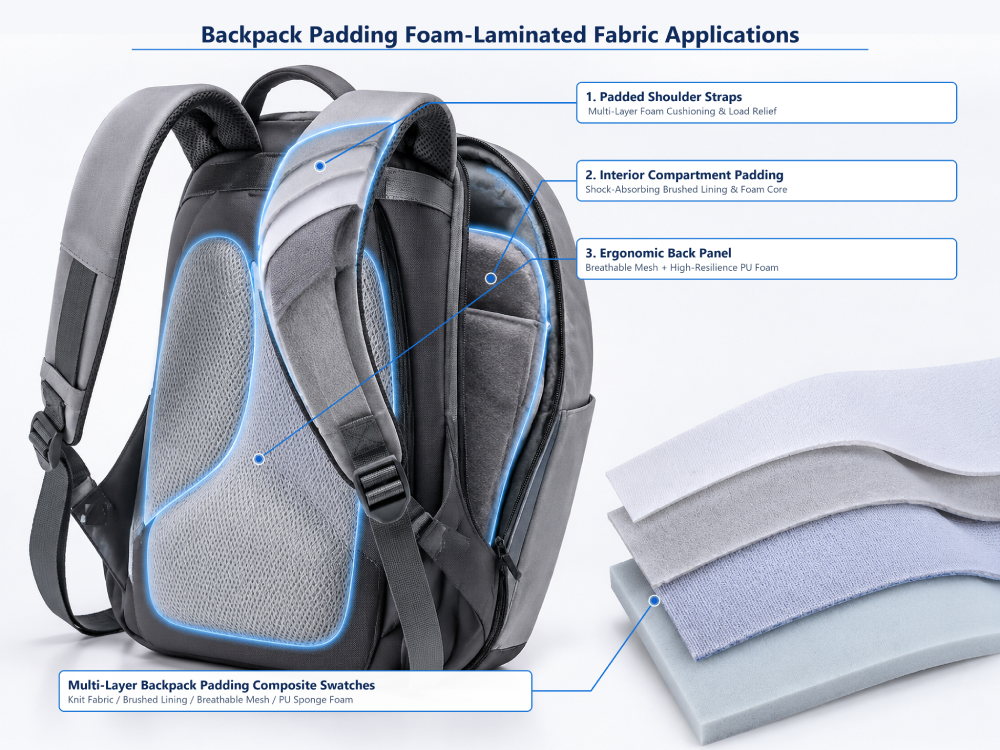
For example, a back panel may combine mesh, outer fabric, foam, and other supporting materials. Shoulder straps usually need to be cut into curved shapes and sewn together with binding materials and webbing. Internal padding may need to fit specific dimensions for laptop compartments, equipment protection, or other internal sections.
For backpack manufacturers, the key question is not simply which foam type sounds better. It is whether the combination of foam, fabric, and lamination structure meets the requirements of a specific component and can go through cutting, sewing, and assembly smoothly.
This article explains how to select foam laminated fabrics for backpack back panels, shoulder straps, and internal padding, and what manufacturers should verify through samples before bulk purchasing.
Which Backpack Components Need Foam Padding?
Foam padding may be used in several backpack components, including the back panel, shoulder straps, sides, and internal compartments. These components do not necessarily require the same material structure. Buyers should first identify the final application before selecting a foam laminated fabric.
Back Panel Padding
The back panel is usually located on the side of the backpack that faces the user's back. Depending on the backpack design, it may combine outer fabric, foam, mesh, or other supporting materials. During material development, manufacturers need to confirm the overall thickness, outer surface requirements, internal construction, and connection method with the main backpack body.
Shoulder Strap Padding
Shoulder strap padding is usually placed inside the shoulder straps. The material needs to be cut, curved, bound, and sewn to create the required strap shape. In addition to foam thickness, manufacturers should consider fabric flexibility, the stability of the laminated layers, and the total material thickness in sewing areas.
Side Padding
Backpack side padding may be used for cushioning, localized filling, or maintaining the shape of a particular component. Whether foam padding is required depends on the backpack design. Not every backpack needs a separate foam layer on its sides.
Internal Padding
Internal padding may be used in laptop compartments, tablet compartments, camera bag sections, or other areas designed to protect stored items. Buyers should confirm whether the padding will directly contact the items, whether fabric is required on both sides, and what dimensions and sewing methods are needed for the finished component.
Although all these components may use foam, their structures and processing requirements are different. Backpack manufacturers should identify the final application first and then determine whether a single-sided laminate, double-sided laminate, or another material combination is required.
What Are the Differences Between Foam Structures for Back Panels and Shoulder Straps?
Back panels and shoulder straps are two common applications for backpack foam padding. However, they have different shapes, processing methods, and structural requirements.
Comparison | Backpack Back Panel | Shoulder Strap |
Main position | Back section of the backpack | Inside the left and right shoulder straps |
Common shapes | Flat, divided into sections, or curved structures | Curved, narrow strips, or tapered profiles |
Substrate considerations | Knitted fabric, mesh, nylon fabric, or other suitable substrates | Flexible fabrics, knitted fabrics, nylon, or other suitable substrates |
Main processing considerations | Surface area, thickness, section structure, and connection to the backpack body | Curved cutting, folding, edge binding, and sewing |
Sample evaluation | Overall construction, surface condition, and assembly compatibility | Bending behavior, sewing positions, and edge finishing |
For a back panel, buyers need to clarify whether the foam laminated material will serve as one layer within the back panel or as a separate padding component. If the backpack design also includes a mesh covering, support board, or other structural materials, these should be distinguished from the foam laminated fabric.
For shoulder straps, the main consideration is whether the material can follow the required strap profile and sewing construction. Foam laminated fabric may need to be cut, folded, or edge-bound before being connected to other strap materials. Therefore, its suitability cannot be judged only by looking at a flat sample.
It is also important to understand that foam laminated fabric is not a complete backpack back panel or shoulder strap assembly. Webbing, buckles, stitching, outer fabrics, and other supporting structures may all be part of the finished component. Foam laminated fabric is only one material option and does not represent the design performance of the entire backpack carrying system.
How Should PU, EVA, PE, and High-Resilience Foam Be Evaluated?
PU, EVA, and PE foam are all material categories that can be considered during backpack padding development. High-resilience PU foam may also be considered for certain product requirements, but its suitability cannot be determined by the material name alone.
The actual performance of different foams depends on factors such as formulation, density, thickness, hardness, structure, and processing conditions. Buyers should select materials according to the requirements of the finished component rather than assuming that a particular foam type is always the right choice for a back panel or shoulder strap.
PU Foam
PU foam can be considered as a candidate material for foam laminated fabric development. Buyers should evaluate its target thickness, density, hardness, flexibility, and overall condition after lamination.
For back panel or shoulder strap projects, simply specifying "PU Foam" is not enough. The exact foam specifications should be confirmed, along with whether the laminated material can meet the requirements of subsequent cutting and sewing processes.
EVA Foam
EVA foam is another possible option for backpack padding material development. Its suitability should be evaluated according to the specific material grade, thickness, hardness, and finished construction requirements.
If a project requires specific bending, compression, or recovery characteristics, buyers should provide the relevant technical requirements and testing methods. These properties should not be assumed from the material name EVA alone.
PE Foam
PE foam can also be included in the material evaluation process, although different PE foam products may have different structures and specifications. Buyers should confirm whether the selected PE foam can be laminated with the intended fabric and how the resulting material performs during cutting, sewing, and assembly.
PE foam should not automatically be considered suitable for every back panel or shoulder strap simply because the product requires padding.
High-Resilience PU Foam
High-resilience PU foam can be considered as an option for evaluation. Buyers should specify the required grade, density, hardness, and recovery-related requirements, and confirm them through technical information and samples.
High-resilience foam is not necessarily more suitable than standard PU foam for every backpack project. The final choice should depend on the component structure, application requirements, cost, and actual sample results.
For all these foam types, buyers should distinguish between density, hardness, and resilience. These are different properties and cannot replace one another. If a project has specific compression, recovery, or durability requirements, the corresponding test methods and acceptance criteria should be defined in advance.
How Should Knitted Fabric, Nylon, Mesh, and Nonwoven Fabric Be Selected?
The performance of foam laminated materials is influenced not only by the foam but also by the fabric substrate. The substrate can affect the laminated material's surface, flexibility, structural stability, and downstream processing behavior.
Backpack manufacturers can evaluate different substrate options according to the design requirements of each component.
Knitted Fabric
Knitted fabric can be considered as a substrate for foam laminated materials. Buyers should check the specific knitting structure, fiber composition, GSM, thickness, and surface characteristics.
If the material needs to undergo bending, wrapping, or sewing, the actual laminated sample should be tested to evaluate its behavior during processing. The final result cannot be determined from the general term "knitted fabric" alone.
Nylon Fabric
Nylon refers to a fiber material, so its specific fabric construction should also be identified. For example, buyers need to clarify whether the nylon fabric is woven or knitted, as well as its GSM, thickness, and surface treatment.
For back panel or shoulder strap projects, manufacturers should confirm whether the nylon fabric meets the intended surface requirements and whether the laminated material is suitable for cutting, sewing, and assembly.
Mesh Fabric
Mesh fabric is a common substrate option considered in backpack material development, particularly for designs that use an open mesh surface on the back panel or other components.
However, an open mesh structure does not automatically mean that the finished laminated material will have a specific level of breathability. The foam structure, lamination method, and additional covering layers may all affect the airflow of the final material. If a backpack project has specific breathability requirements, the test object and testing standard should be defined for the complete laminated material.
Nonwoven Fabric
Nonwoven fabric can also be considered as a substrate in certain foam laminated structures. Buyers should evaluate its fiber composition, GSM, thickness, surface condition, and intended application.
The properties of nonwoven fabrics depend on their fiber composition and web-forming and bonding methods. Therefore, not all nonwoven fabrics should be treated as the same material.
For back panels, shoulder straps, and internal padding, substrate selection should be based on the component structure, surface requirements, and processing methods. For more information about the structural differences between fabric substrates, see Fabric Substrates for Foam Laminated Materials.
How Should Single-Sided and Double-Sided Lamination Be Selected?
Backpack foam laminated materials can use different layer structures according to the surface requirements of the finished component. Common options include single-sided and double-sided lamination. However, more layers do not automatically mean better material performance.
Fabric + Foam
This structure consists of one fabric layer laminated to one foam layer. It can be considered for certain backpack padding applications.
If the other side of the foam will not be exposed in the finished product, or if it will be connected to another material during subsequent processing, buyers can evaluate whether this structure meets the design requirements.
Fabric + Foam + Fabric
This structure places a fabric layer on both sides of the foam. It can be considered when both sides of the material need fabric coverage. However, its suitability for a back panel, shoulder strap, or internal padding component still needs to be confirmed according to the actual design.
For example, if both sides of a shoulder strap require fabric coverage, buyers can evaluate a three-layer structure. If a back panel only requires a specific appearance on one side and the other side will be connected to another component, double-sided lamination may not be necessary.
Other Laminated Structures
Some projects may require additional fabric or other supporting layers. In these cases, buyers should clarify the function, position, and final processing requirements of each layer instead of providing only an overall thickness without explaining the material sequence.
When selecting a laminated structure, manufacturers should first confirm the front and back surface requirements, contact positions, sewing methods, and assembly relationships of the backpack component. The layer structure can then be selected accordingly. Different structures may have different flexibility, total thickness, and processing behavior, so samples are necessary for confirmation.
For more information about single-sided and double-sided foam lamination, see Single-Sided and Double-Sided Foam Laminated Fabric Structures.
How Should Foam Thickness, Density, and Total Laminated Thickness Be Confirmed?
When purchasing backpack padding materials, foam thickness, foam density, and total laminated thickness are three different specifications. Providing only one of these parameters is not enough to define the material completely.
Foam Thickness
Foam thickness is usually measured in millimeters (mm) and refers to the thickness of the foam itself.
Back panels, shoulder straps, and internal padding may require different foam thicknesses depending on the design. Buyers should determine the target thickness according to the component drawings, available internal space, and sewing construction rather than applying one standard thickness to every component.
Foam Density
Foam density describes the mass of foam per unit volume. It does not directly represent the foam's hardness, softness, or resilience.
Therefore, specifying only a density requirement does not fully define the compression or support characteristics of the material. If a project has requirements for hardness, compression, or recovery, the relevant parameters and evaluation methods should be specified separately.
Total Laminated Thickness
The total thickness of a laminated material is affected by the foam and other layers, such as fabric, backing layers, or additional supporting materials.
The total thickness should not simply be assumed by adding the nominal thicknesses of each individual layer. Material conditions and lamination processes may affect the final result. The actual thickness should be confirmed using laminated samples and an agreed measurement method.
Backpack manufacturers can use the following table to organize their material specifications:
Specification | Information to Confirm |
Foam material | PU, EVA, PE, or another specified material |
Foam thickness | Target thickness and allowable tolerance |
Foam density | Target density and measurement or testing basis |
Foam hardness | Whether a specific requirement and test method are needed |
Resilience or compression requirements | Whether specific values and acceptance criteria are required |
Fabric substrate | Nylon, knitted fabric, mesh, nonwoven fabric, or another material |
Fabric GSM | Target GSM and allowable tolerance, if applicable |
Lamination structure | Single-sided, double-sided, or another multilayer construction |
Total thickness | Target laminated thickness and measurement method |
If a backpack manufacturer has not yet decided on the appropriate foam specifications, it can provide existing material samples, component drawings, or application details first. The supplier can then discuss possible material options for evaluation.
How Can Material Suitability Be Verified Through Cutting, Sewing, and Sample Assembly?
A foam laminated material may look suitable in a flat sample, but that does not necessarily mean it is ready for a backpack production line. Backpack components usually require cutting, sewing, edge binding, and assembly. Buyers should therefore evaluate samples under conditions that are as close as possible to actual production.
Cutting Evaluation
Back panels, shoulder straps, and internal padding may have different shapes. Back panels may require large-area or sectional cutting. Shoulder straps may involve curved profiles and narrow strips, while internal padding needs to match the dimensions and edge construction of the compartments.
After cutting, buyers should check whether the foam edges show noticeable deformation, whether the fabric and foam have shifted relative to each other, and whether the cut edges are suitable for subsequent sewing or edge binding.
Sewing Evaluation
The total thickness, fabric construction, and number of layers in foam laminated materials may all affect the sewing process.
Buyers should conduct trial sewing using the equipment planned for production. They should check whether material feeding is stable, whether the stitches meet appearance requirements, whether the fabric and foam shift relative to each other, and whether noticeable wrinkles or deformation occur around the sewn areas.
Needle type, thread, stitch length, presser foot, and feeding conditions should be confirmed according to the specific material and equipment. There are no universal fixed settings suitable for every foam laminated fabric.
Edge Binding and Assembly Evaluation
Shoulder straps usually need to be connected with binding materials, webbing, or other components. Back panels may need to be assembled with the backpack body and internal supporting structures. Internal padding may need to be sewn together with compartment fabrics.
Therefore, sample evaluation should not stop at the foam laminated fabric itself. Buyers should make actual component samples whenever possible and check the shape and material condition after bending, edge binding, sewing, and assembly.
A Suggested Sample Approval Process
Step 1: Identify the final application of the foam laminated fabric, such as a back panel, shoulder strap, side padding, or internal compartment.
Step 2: Confirm that the sample and intended bulk material have the same foam, substrate, layer structure, and thickness.
Step 3: Conduct trial processing in the actual production sequence, including cutting, sewing, edge binding, and assembly.
Step 4: Record any issues involving cut edges, layer movement, stitch appearance, material deformation, and assembly compatibility.
Step 5: Confirm the approved sample specifications and acceptance criteria, and use the approved sample as a reference for subsequent bulk purchasing.
If a project has requirements for peel strength, compression, resilience, or durability, the testing methods and acceptance criteria should be defined in advance. Final performance should not be guaranteed based only on the material's appearance or the supplier's description of its material type.
What Information Should Backpack Manufacturers Provide Before Requesting a Quotation?
For a foam laminated fabric supplier, a description such as "we need foam for backpacks" is usually not enough to determine the exact material structure. Backpack manufacturers should provide as much of the following information as possible so that the supplier can understand the component requirements and evaluate suitable material options.
RFQ Information | Recommended Details |
Final application | Back panel, shoulder straps, side padding, laptop compartment, or other internal padding |
Product type | Backpack, laptop bag, camera bag, travel bag, or other bag |
Component drawings | Dimensions, shape, cutting templates, or existing samples |
Foam type | PU, EVA, PE, high-resilience PU, or not yet determined |
Foam specifications | Thickness, density, hardness, and other specific requirements |
Fabric substrate | Nylon, knitted fabric, mesh, nonwoven fabric, or another material |
Lamination structure | Fabric + Foam, Fabric + Foam + Fabric, or another structure |
Overall specifications | Total laminated thickness, width, GSM, and allowable tolerances |
Downstream processing | Cutting, sewing, edge binding, bending, and assembly methods |
Supply format | Rolls, sheets, or another confirmed delivery format |
Order information | Sample quantity, initial order quantity, and estimated future purchasing volume |
Acceptance requirements | Appearance, dimensions, layer bonding, and other specified testing standards |
If the foam type or lamination structure has not yet been decided, buyers do not need to make assumptions. They can first provide backpack photos, component drawings, existing material samples, and the intended application. The supplier can then discuss possible material structures based on the actual requirements.
HuiZhou JinHaoCheng Nonwovens Co., Ltd. has project experience in laminating PU and EVA foam with different fabrics, involving flame lamination, adhesive lamination, and hot-melt lamination. Depending on the project, processing may be carried out internally or externally. Specific material combinations, production arrangements, and sample results need to be confirmed for each project.
For backpack back panels, shoulder straps, and internal padding, the final material selection should still be based on the actual component structure, laminated samples, and downstream processing verification. Confirmation of a material combination by the supplier does not mean that the complete backpack component has already been designed or assembly-tested.
When purchasing foam laminated fabrics for backpacks, manufacturers should first identify the final application of the material and then select the foam, substrate, and lamination structure according to the component requirements. Verifying the material through actual cutting, sewing, and assembly samples helps ensure that purchasing specifications match downstream production requirements.




