Foam Backing for Handbags: Padded Fabrics for Shape, Structure and Sewing
The appearance of a handbag or shoulder bag depends not only on its outer fabric but also on the interlining, padding, and structural support materials used inside.
During bag development, some areas need a soft feel, some require a certain thickness and padded appearance, while others need to work with additional materials to maintain the bag's shape. The construction requirements of the main body, side panels, bottom, and interior panels are different. Therefore, one material cannot automatically meet the requirements of every component.
Foam backed fabric is one composite material option for handbag development. It combines foam with fabric to create a material with a certain thickness, softness, and surface appearance. It can be considered for bag components that require flexible padding or a foam-backed fabric structure.
However, foam backed fabric is not the same as a complete handbag structural board. It cannot directly replace rigid reinforcement materials such as PP boards, molded EVA panels, or cardboard stiffeners. Buyers need to select the appropriate material structure according to the position of each bag component, appearance requirements, and subsequent processing methods.
Which Areas of Handbags and Shoulder Bags Need Foam Padding or Structural Support?
The internal construction of handbags and shoulder bags varies according to the bag style, dimensions, design, and intended use. Not every bag requires foam backing, and not every component that needs support is suitable for foam laminated fabric.
Common material application areas include the following:
Bag component | Possible material requirements | What buyers should consider |
Front and back body panels | Flexible padding, surface flatness, and a certain thickness | Fabric appearance, foam thickness, overall flexibility, and sewing requirements |
Side panels | Flexible padding or localized support | Panel thickness, folding, bending, and edge-binding requirements |
Bag bottom | Padding, cushioning, or separate structural support | Bottom shape, load requirements, material stiffness, and connection methods |
Flaps and covers | Flexible padding or laminated backing | Surface flatness, folding positions, and edge finishing |
Interior pockets and compartments | Lining fabric or localized foam laminated material | Material thickness, pocket space, sewing positions, and hand feel |
Shoulder straps and connecting areas | Flexible padding or other support materials, depending on the design | Thickness, bending, sewing structure, and actual load-bearing positions |
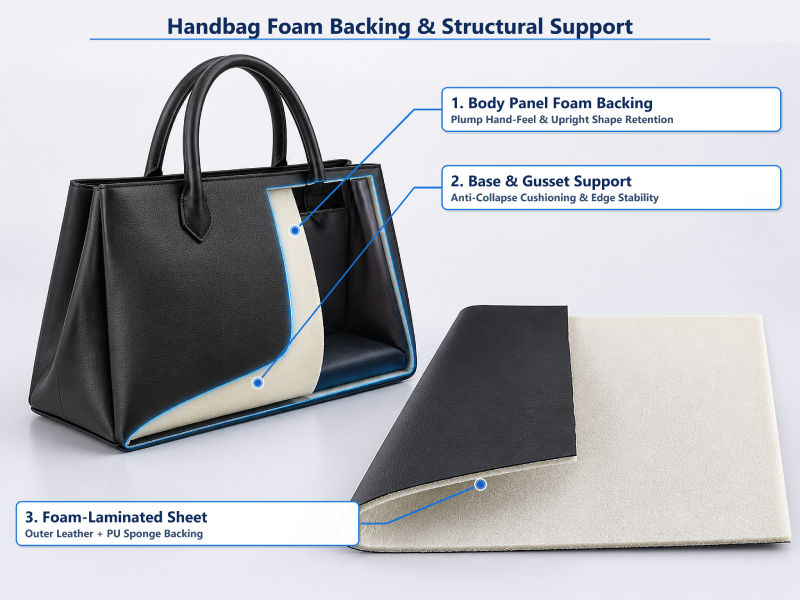
For example, foam may be laminated to the back of the outer fabric on the front and back body panels to provide a certain thickness and soft feel. Side panels may need to bend or fold, so their flexibility and surface condition after folding should also be evaluated.
Material selection for the bottom requires more careful consideration. If the design requires the bottom to maintain a relatively stable shape, a separate rigid reinforcement material may be necessary rather than relying only on foam backed fabric.
For shoulder straps, decorative padding should also be distinguished from structural load-bearing components. Foam laminated fabric may be evaluated as a flexible material option, but it should not be treated as a complete shoulder strap support system.
Therefore, buyers should first identify the specific function of each component before deciding whether to use foam, ordinary interlining, or separate structural support materials.
What Are the Different Material Requirements for Bag Bodies, Side Panels, Bottoms, and Interior Padding?
Although different handbag components may use the same types of foam or fabric, their actual material requirements are not necessarily the same.
Main body panels generally require attention to finished appearance, surface flatness, thickness, and overall hand feel. Foam backing may be used to increase panel thickness and provide a softer feel, but buyers need to confirm whether lamination affects the texture and appearance of the outer fabric.
Side panels need to be evaluated in relation to the three-dimensional construction of the bag. They may need to bend, fold, or be sewn to the front and back panels. In addition to thickness and hand feel, flexibility and surface condition after folding should be considered.
Bottom panels may require padding or additional structural reinforcement. Foam backed fabric can be evaluated as a flexible padding option. However, if the bottom needs to maintain a specific shape or provide structural support, buyers should separately consider whether PP boards, molded EVA panels, cardboard, or other reinforcement materials are required.
Interior linings and pockets are more concerned with internal space, surface feel, material thickness, and sewing suitability. Not every interior pocket needs a foam laminated structure. Ordinary lining fabric may already meet the requirements of some areas.
Component | Main considerations | Possible material options |
Front and back body panels | Appearance, hand feel, thickness, and surface flatness | Fabric + Foam |
Side panels | Bending, folding, sewing, and edge binding | Flexible foam laminated fabric or ordinary interlining |
Bottom | Shape, load requirements, and structural stability | Foam laminated materials combined with separate reinforcement materials |
Flaps and covers | Surface appearance, folding, and edge finishing | Single-sided or double-sided foam laminated structures |
Interior pockets and compartments | Space, thickness, hand feel, and sewing | Ordinary lining fabric or localized foam backing |
These are material development options, not standard constructions for every handbag. The final selection should be based on the actual bag style, design drawings, and samples.
What Is the Difference Between Foam Backed Fabric, Ordinary Interlining, and Nonwoven Interlining?
In handbag manufacturing, ordinary interlining, nonwoven interlining, and foam backed fabric may all be used behind outer fabrics or within internal structures. However, their compositions and functions are different.
Foam backed fabric is made by laminating foam with fabric. The foam layer provides a certain thickness and flexible padding, while the fabric layer determines the surface appearance of the composite and is also involved in subsequent processing.
Ordinary interlining is mainly used to support fabric construction, improve fabric handling, or work with the structure of a bag. Different interlinings may use different materials and constructions, and they do not necessarily contain a foam layer.
Nonwoven interlining is primarily made from nonwoven material. Its specific softness, thickness, structure, and application depend on its fiber composition and manufacturing method. The term "nonwoven" alone does not indicate whether the material can provide sufficient structural support.
Material type | Basic construction | Main function | What buyers should confirm |
Foam backed fabric | Fabric + Foam | Flexible padding, added thickness, and surface feel | Foam type, thickness, fabric surface, and lamination structure |
Ordinary interlining | Varies by material type and may not contain foam | Supports fabric construction or bag structure | Material composition, thickness, stiffness, and intended use |
Nonwoven interlining | Nonwoven material formed from a fiber web through an appropriate bonding process | Padding, auxiliary support, or internal material | Fiber composition, GSM, thickness, softness, and structure |
Rigid reinforcement material | PP boards, molded EVA panels, cardboard, or other boards | Provides shape or structural support in specific areas | Thickness, stiffness, shape, processing, and installation method |
These materials should not be treated as direct substitutes for one another.
For example, foam backed fabric can be evaluated when a bag body requires flexible padding. Ordinary interlining may be more suitable when the main purpose is to support the outer fabric during construction. If a component needs a more defined level of stiffness or structural support, separate reinforcement boards may be required.
Foam laminated fabric is not the same as a complete handbag structural board. Even when the foam has a certain thickness, the finished bag's ability to maintain its shape over time cannot be determined from the material name or thickness alone.
Buyers should distinguish between flexible padding and rigid reinforcement according to the design requirements, then decide whether the two types of materials need to be used together.
How Should PU, EVA, and PE Foam Be Used in Handbag Structure Development?
During the development of foam backing materials for handbags, PU, EVA, and PE foam can be evaluated as different material options. However, buyers should not decide which one is most suitable based only on its material name.
Foam type | Specifications to confirm during development | Considerations for handbag applications |
PU Foam | Type, thickness, density, hardness, and compression characteristics | Softness, hand feel, bending behavior, and performance after lamination |
EVA Foam | Material grade, thickness, hardness, and specific physical characteristics | Padding requirements, material flexibility, and processing suitability |
PE Foam | Material type, thickness, density, and processing requirements | Material structure, surface condition, and lamination suitability |
PU foam is available in different grades with different softness and elasticity characteristics. It can be evaluated for bag body panels that require a soft feel or a certain degree of padding. However, different PU foam grades may have different densities, hardness levels, and compression characteristics. Not all PU foams provide the same hand feel.
EVA foam can also be evaluated according to its material grade and specific construction. Buyers need to clarify whether it is intended for flexible padding or another structural purpose, and confirm its thickness, hardness, and suitability for subsequent processing. The fact that EVA is used in other bag or footwear products does not mean that every EVA specification is suitable for all handbags.
PE foam also needs to be assessed according to its specific type and specifications. Different PE foams may vary in structure, compression behavior, and processing methods. Ordinary EPE and cross-linked PE should not be treated as exactly the same material.
In addition to the foam itself, the fabric substrate affects the appearance and processing characteristics of the final composite. Knitted fabric, woven fabric, nonwoven fabric, and other suitable fabrics can all be considered as potential substrates. Their suitability needs to be confirmed according to fiber composition, GSM, thickness, surface condition, and lamination requirements.
If buyers have not yet decided on the foam type, they can first provide the intended application position, appearance requirements, and existing samples. The appropriate material combination can then be discussed based on the actual project.
For a general comparison of different foam types, refer to the comparison of PU, EVA, and PE foam laminated materials.
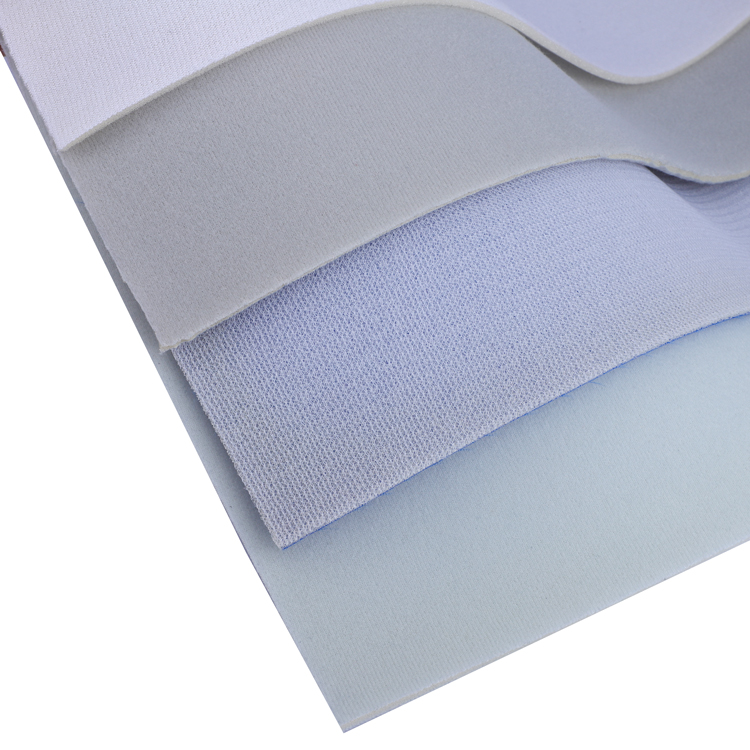
How Do Fabric Surfaces, Colors, and Textures Affect the Appearance of Foam Backed Materials?
For handbag manufacturers, foam backing materials need to meet not only thickness and softness requirements but also the appearance expectations of the finished bag.
Even when the same foam is used, different fabric substrates may create different surface textures, color effects, and hand feels. Therefore, buyers cannot determine whether the final composite meets the bag design requirements by looking at foam specifications alone.
Fabric surface texture directly affects the visual appearance and touch of the finished bag. Buyers should clarify whether the outer material requires a smooth surface, a textile texture, or another specific appearance. The surface condition before and after lamination should be checked through samples.
Color requirements should also be confirmed in advance. If the outer fabric has a specified color, the supplier needs to check whether the color and surface appearance after lamination match the reference sample. The final result should not be determined only by a color name.
Fabric GSM and thickness affect the total laminated thickness and hand feel. If the fabric itself is relatively thick, adding a foam layer may change the feel of the bag body panels and their sewing characteristics.
Fabric construction and stretch direction also need to be considered. Different knitted, woven, and nonwoven substrates have different structures, which may lead to different results during bending, folding, and sewing after lamination.
Fabric factor | Possible effect on the composite | What buyers should confirm |
Surface texture | Finished appearance and hand feel | Reference fabric, surface finish, and samples |
Color | Visual appearance of the finished product | Color swatch or physical sample |
GSM and thickness | Total laminated thickness and hand feel | Individual fabric specifications and total thickness |
Fabric construction | Flexibility, stretch, and processing behavior | Specific construction, such as knitted, woven, or nonwoven |
Fiber composition | Physical characteristics and lamination suitability | Actual fiber content, such as PET, nylon, or other fibers |
If a project has strict appearance requirements, buyers are advised to provide actual outer fabric samples rather than only color names or product photographs.
For more information about different fabric substrate constructions, refer to the guide to fabric substrates for foam laminated materials.
How Should Single-Sided and Double-Sided Lamination Structures Be Selected?
For handbag foam backing materials, buyers can consider single-sided or double-sided lamination according to the surface requirements on both sides of the composite.
A common single-sided lamination structure is:
Fabric + Foam
This structure consists of one fabric layer and one foam layer. It can be considered when only one side of the composite material requires a fabric surface.
A double-sided lamination structure can use:
Fabric + Foam + Fabric
The foam is positioned between two fabric layers. This structure can be considered when both sides require fabric coverage.
Lamination structure | Basic construction | Considerations during handbag development |
Single-sided lamination | Fabric + Foam | Outer fabric surface, foam thickness, and how the other side connects to additional materials |
Double-sided lamination | Fabric + Foam + Fabric | Surface requirements on both sides, total thickness, and sewing suitability |
If the outside of a bag body requires a specified fabric appearance while the other side will be connected to interior materials, single-sided lamination may be an option to evaluate.
If a flap, divider, or other component requires fabric surfaces on both sides, double-sided lamination can be considered.
However, double-sided lamination is not necessarily better than single-sided lamination. Adding another fabric layer may change the total thickness, flexibility, and sewing characteristics. It may also affect the material's behavior during folding or edge binding.
Therefore, buyers should select the structure according to the surface requirements on both sides of the finished component, connection methods, and subsequent processing requirements, rather than simply choosing more material layers.
For more information about different lamination structures, refer to the guide to single-sided and double-sided foam laminated fabric structures.
How Can Folding, Sewing, and Edge Binding Confirm Whether Foam Backing Is Suitable?
A foam backed material that looks suitable when laid flat is not necessarily suitable for actual handbag production.
During bag manufacturing, materials may go through cutting, folding, sewing, edge binding, and multi-layer assembly. Therefore, sample validation should be as close as possible to the actual production conditions.
Folding tests are used to observe the material's surface condition at folded areas. Buyers should check for visible wrinkles, excessive foam compression, and changes in the laminated layers that may affect the finished appearance.
Sewing tests should confirm whether the material thickness is suitable for the planned equipment and sewing method. Different foam thicknesses and fabric constructions may affect stitch appearance, feeding, and multi-layer connections. Stitch length, needle type, thread, and equipment settings should be confirmed according to the actual material rather than applying universal values.
Edge-binding tests should examine the material edges after bending and wrapping. If the material is too thick or does not have suitable flexibility, it may affect edge flatness, binding appearance, and sewing positions.
Multi-layer assembly tests involve combining the foam laminated fabric with other bag fabrics, interlinings, or reinforcement materials to check the overall thickness, panel shape, and sewing results.
Buyers are advised to evaluate samples in the following order:
Validation stage | What to check |
Flat condition | Surface texture, color, thickness, and lamination condition |
Folded condition | Creases, foam deformation, and surface wrinkles |
Cutting condition | Cut edges, material layers, and dimensions |
Sewing condition | Stitch appearance, feeding, material movement, and seam quality |
Edge-binding condition | Edge thickness, bending behavior, and binding flatness |
Finished assembly | Bag body shape, overall hand feel, and component connections |
If a project requires long-term shape retention, fold resistance, or resistance to collapse, the test method, test conditions, and acceptance criteria need to be specified in advance. Long-term performance should not be guaranteed based only on the foam type or the result of a single manual folding test.
The final assessment should be based on actual bag samples and bulk production conditions, rather than a flat piece of laminated material alone.
What Information Should Handbag Manufacturers Confirm Before Purchasing Foam Backing Materials?
To reduce misunderstandings during material development, handbag manufacturers should provide as much information as possible about the bag construction, material application positions, and actual processing requirements before requesting a quotation.
Information category | Details to provide |
Bag type | Handbag, shoulder bag, tote bag, or another specific bag style |
Material application position | Bag body, side panels, bottom, flap, pocket, or interior panel |
Drawings or photographs | Bag drawings, component photographs, existing samples, or reference images |
Outer fabric | Fabric type, fiber composition, GSM, thickness, color, and surface texture |
Foam requirements | PU, EVA, PE, or material to be evaluated, together with thickness, density, and hardness requirements |
Lamination structure | Fabric + Foam or Fabric + Foam + Fabric |
Total material thickness | Foam thickness and required total laminated thickness |
Structural reinforcement | Whether separate PP boards, molded EVA panels, cardboard, or other reinforcement materials are required |
Further processing | Cutting, folding, sewing, edge binding, and assembly methods |
Appearance requirements | Color, surface texture, hand feel, and reference samples |
Project information | Sample requirements, estimated order quantity, lead time, and acceptance requirements |
If buyers have not yet decided on the foam type or lamination structure, they can first provide bag photographs, construction drawings, and existing fabric samples. The supplier can then discuss possible material combinations according to the specific application.
For foam laminated materials, HuiZhou JinHaoCheng Nonwovens Co., Ltd. has experience combining PU/EVA foam with different fabrics. These projects involve flame lamination, adhesive lamination, and hot-melt lamination. Depending on individual project requirements, the related processing may be completed internally or through external processing partners.
For specific handbag projects, material combinations still need to be evaluated according to the outer fabric, foam specifications, lamination structure, and actual sewing requirements. General foam lamination experience should not be treated as proof that every handbag material combination has already been validated. Foam backed fabric should also not be assumed to replace complete rigid structural reinforcement materials.
Providing accurate bag component positions, fabric samples, construction drawings, and downstream processing requirements is a practical starting point for selecting a foam backing solution and moving forward with sample development.